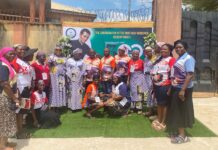

BARAGIANO (PZ) — If there is a place where the roots of Saint Gerard Majella are deeply rooted in history and humanity, it is Baragiano. It is precisely here that the Saint’s paternal branch originated, a unique historical record that makes this Lucanian town a leader in the promotion and worship of the humble Redemptorist lay brother. In the year of the Tercentenary of his birth, the local community has responded to history’s call with a rich and heartfelt program of liturgical and cultural events, impeccably led by the parish priest, Father José Conti.
Faith and people in Baragiano Scalo: a triduum of hope
The heart of the celebrations was the parish church dedicated to the Saint in Baragiano Scalo. Between the aisles of the large liturgical hall, the festively decorated statue of Saint Gerard served as a backdrop for the traveling exhibition of vintage holy cards from Muro Lucano, expertly painted by Antonio Mennonna.
October 12, 13, and 14 marked the triduum of prayer and preparation led by Father José, culminating in the solemn pilgrimage of the entire community to the Shrine of Materdomini. There, after a welcome by the rector, Father Serafino Fiore, already familiar to the Baragiano community, the Eucharistic celebration, presided over by the Metropolitan Bishop of Potenza, Monsignor Davide Carbonaro, concluded with the traditional rite of offering oil for the votive lamp that burns before the relics of the Saint—a symbolic gift presented by the city of Muro Lucano, represented by the mayor and the parish priest.

The highlight of the festivities was October 16th, the liturgical feast of the parish’s patron saint. At 6:30 PM, a large congregation filled the church for Mass, presided over by Redemptorist missionary Father Vincenzo M. La Mendola and concelebrated by parish priest Father José Conti, the true organizing force behind the entire calendar.
In his homily, Fr. La Mendola delivered a strong and concrete message: “Holiness is possible even today. Saints are those who contribute to the betterment of humanity, transforming it into a magnificent humanistas. Gerard is a man of our joy and hope, a ‘Lucanian saint’, who demonstrates the goodness and fruitfulness of this land, where living the Gospel is possible, today as yesterday.”
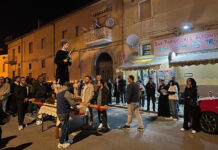
The liturgy was enriched by the singing of the parish choir and the altar servers. This was followed by the highly anticipated extraordinary event of the Gerard Year: the solemn procession along the main street. The procession was led by a large group of mothers, children, and devotees, who alternated prayers and songs with fervent cheers. Amidst the spectacular fireworks display along the route and the impressive fireworks display at the finish line, the evening concluded with a moment of intense spirituality: the blessing of the mothers and children who crowded the sanctuary, the act of intercession, the kissing of the relic, and the homage to the statue, where each faithful entrusted their hopes and expectations to Saint Gerard.
In the Historic Center: Between Family Roots and a Silver Halo
On Sunday, October 18th, the focus of the celebration shifted to the historic center. At 10:30 a.m., the procession carrying the statue and relic departed from the Church of the Annunziata to the small temple in the Franciosa district. Tradition holds that this site is adjacent to the ancient home of the “Machiella,” the family of Saint Gerard’s father, Domenico, who had moved from Picerno in the second half of the 16th century.
A representative of the village’s residents awaited the statue on a splendid morning of sunshine and blue skies. In front of the votive shrine, carefully prepared, the open-air Eucharist was celebrated. The preacher described it as a spontaneous and intimate event, free of pomp and circumstance, but lived with sincere faith and composed piety—faithful to the style of a Saint who was “a simple man among the simple, with his eyes to heaven and his feet on the ground, a generator of hope and a worker of the Gospel of charity among the poor.”


The Mass was marked by a highly symbolic gesture: the inauguration and blessing of a new silver halo donated to the Saint and placed on his statue, “a sign of the desire to imitate him and be inspired by his testimony.” The mayor and civil and military authorities attended the event, demonstrating how deeply Majella’s figure is embedded in the citizenry’s identity.
“Saint Gerard is one of you,” Father La Mendola emphasized in his homily. “His steps have traversed these same roads, and his eyes have admired these splendid hilly panoramas. Let him inspire you as you think about and build the future of this community.”
On a sunny October afternoon, after Don José thanked the entire community for their commitment to promoting the festival and Baragiano’s historical roots, a new procession accompanied the statue back to its church.
History and Faith: A Presentation of Chiara Ponte’s Essay
The intense program concluded with a major cultural event that attracted massive public participation: the presentation of the essay “San Gerardo Maiella tra storia e tradizione popolare,” a work now in its second edition and written by Dr. Chiara Ponte.
The conference was held at 7:30 PM in the parish hall. Hosting and moderating the evening was Father José Conti, who introduced the theme in the context of the Tercentenary celebrations and introduced the speakers. His greetings were followed by those of the mayor, Dr. Giuseppe Galizia, who expressed his honor to have contributed, with his administration, to making the celebrations of the anniversary of St Gerard even more meaningful.


The floor was then given to Father Vincenzo M. La Mendola—a member of the Redemptorist Historical Institute in Rome, an archivist, and a scholar of ecclesiastical history—who offered an effective and comprehensive summary of the work. Father La Mendola highlighted the rigor of the author’s historical-critical method, calling her “the first female biographer of the Saint from Murgia, capable of portraying Saint Gerard from a female perspective, while simultaneously sketching a blatantly ‘Lucanian’ profile of her fellow citizen and recounting his travels and encounters—sometimes miraculous—with his people.” This brilliant and insightful presentation was particularly appreciated by the audience for its clarity and scholarly rigor (qualities that had already emerged during his sermons during the triduum at Materdomini).
Subsequently, prompted by Don José’s questions, author Chiara Ponte spoke. Her focus was on the topic closest to the heart of the Baragiano community: the paternal lineage and the origin of the Saint’s surname. Despite her emotion, the young Lucanian writer responded with great command of language and argumentative rigor, winning over the audience with her expertise and courage in tackling a work that intertwines history, spirituality, and popular devotion.
A path that continues
After a lively discussion with the audience, Father José concluded by reiterating the entire community’s gratitude for a moment of cultural growth that nourishes and strengthens local identity. A testament to the evening’s success, countless faithful lined up to purchase a copy of the essay.
As Father Vincenzo recalled in his speeches: Baragiano is not just any town of St Gerard: it is the place where the roots of the humanity of Gerard Majella lie, the humble Redemptorist layman whose life gave rise to a spiritual movement that has now spread throughout the world. It all began here!
The gratitude of the entire citizenry goes to the parish priest, Don José, and all the collaborators for the impeccable direction of these days. But this extraordinary Centenary is not a point of arrival: it is only one stage in a long journey that continues.
Carmine Antonio Passannante