


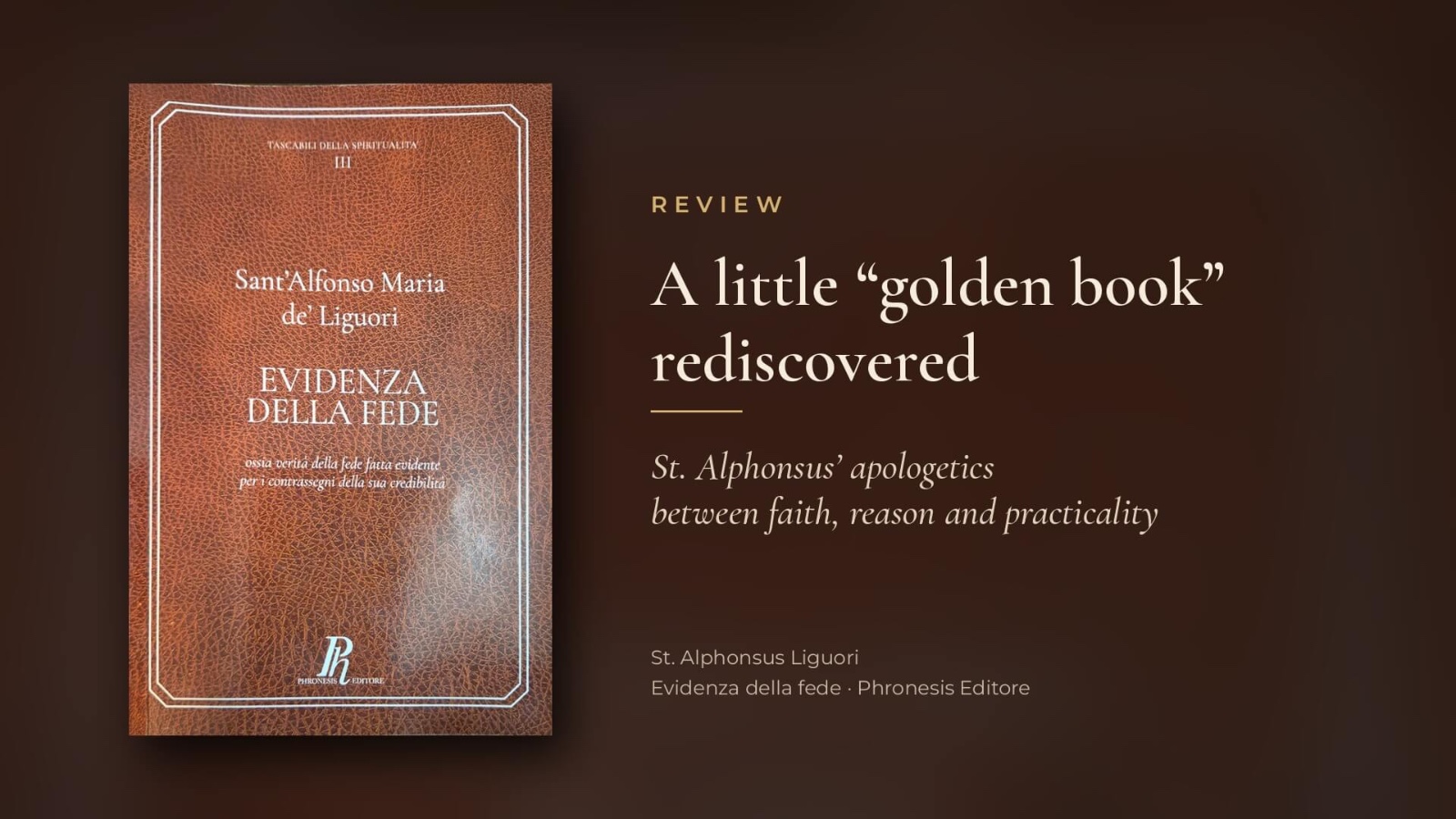
After more than a century of silence in publishing, Evidenza della fede (“The Evidence of Faith”) by St. Alphonsus Liguori returns to bookstores; a short apologetic treatise that the saint himself described as “a little book of gold.” A new edition, edited by Adriano Virgili for Phronesis Editore, restores its contemporary relevance, characterized by rigorous argumentation, pastoral practicality, and an extraordinary dialogic style.
Saint Alphonsus Maria de Liguori, Evidenza della fede, ossia verità della fede fatta evident per i contrassegni della sua credibilità (“The evidence of faith, or the truth of faith made evident through the signs of its credibility”), edition of A. Virgili, Phronesis Publisher, Palermo 2022, 123 pages.
Determining precisely the number of editions of the works of St. Alphonsus Liguori—reprinted countless times throughout the centuries, right up to the present day—is always a complex task. The challenge is even greater when dealing with writings that have fallen into oblivion or have not been republished for a long time; a fate often befalling a literary genre in which the saint was very prolific, but for which he is less well known today: apologetics.
The origins of The Signs of Faith
Originally published in 1762—a pivotal year marked by the saint’s episcopal appointment and consecration—the work is primarily known by the abbreviated title the author himself gave it in a letter to the publisher Giambattista Remondini, dated November 27, 1762. The treatise received its imprimatur on October 14, 1763, and Alfonso himself described it with laudatory praise: “a little book of gold” (De Meulemeester, I, 120). It is a concise and incisive treatise that establishes the credibility and truth of the Catholic faith through rigorous arguments drawn from Sacred Scripture, Tradition, and theology.
According to Maurice De Meulemeester’s General Bibliography, the last reprint dates from 1889 (in Rome), while the prestigious Turin-based publisher Marietti included it in 1880 in a single-volume compilation of his dogmatic works. This long period of editorial silence lends special value to this new edition.
A response to the challenges of the 18th century
The editor, Adriano Virgili, emphasizes how Saint Alphonsus was, “possibly, the most influential Catholic theologian of his time” (p. 5), called upon to confront the cultural obstacles of his era: deists and materialists were launching constant attacks against the foundations of the Catholic faith. Faced with such threats, the saint responded not only with profound and erudite theological works, supported by solidly reasoned arguments, but also with concise and accessible treatises—aimed at a broad audience beyond the academic sphere—at a time when books were becoming increasingly widespread. This is precisely the case with this work, structured in twelve coherent chapters that clearly demonstrate the truth and intrinsic evidence of the Catholic faith, while refuting—with equally sound argumentation—the inconsistencies of other religions.
The structure of the work: from the fundamentals to the practice
The itinerary outlined by Saint Alphonsus is essentially divided into two main parts: eight chapters of a fundamental and expository nature, followed by four eminently practical chapters—in full harmony with the saint’s style, always oriented towards pastoral concreteness.
- The fundamental chapters (I–VIII): the sanctity of the doctrine; the conversion of the world; the stability of the dogmas, which remain constant throughout time; the testimony of the prophecies; the testimony of the miracles; the heroic constancy of the martyrs; and the conclusion of the theoretical exposition.
- The practical and applied chapters (IX–XII): the concrete practice of faith; maxims of faith that should always be kept in mind; practical reflections on how to obtain spiritual benefit from the visible realities of this life; and a brief method for converting a non-believer to the holy faith.
Faith, reason, and consistency of life
For St. Alphonsus, faith is not a mere feeling, but “a science that surpasses any other science […] infused in us by the divine light, capable of far exceeding all the lights of human and angelic nature” (p. 8).
Anticipating, in a way, the main themes of the encyclical Fides et Ratio, the saint firmly states: “The mysteries of faith are not opposed to reason; rather, they transcend our human reason. Therefore, we must not try to grasp them by means of our own discursive reasoning—as the proud do, who, unable to comprehend them with their limited minds, become entangled in numerous difficulties from which they cannot extricate themselves—” (p. 9).
As the author himself points out, this short work was written precisely to offer “the criteria that assure us of the truth of our faith […] which should help us to see and recognize that the only true faith is the one taught to us by this Catholic Church” (p. 10).
However, as a highly astute moral theologian, Alphonsus is fully aware that theory alone is insufficient: “Believing what the faith teaches is not enough for salvation; it is also necessary to live according to what the faith demands.” And he adds: “The virtuous life of a believer demonstrates that he possesses a true faith” (p. 87).
Indeed, Alphonsus observes that, while “many may believe in the speculative truths of faith—those that pertain to the intellect—few demonstrate belief in the practical truths, which concern the will and the way of life” (p. 88). To bridge this gap, the author includes a veritable handbook of biblical and spiritual maxims—drawn from figures representing the great schools of spirituality, such as Bernardino of Siena, Teresa of Ávila, Philip Neri, and Francis de Sales—designed to be readily available in times of crisis. This is followed by a series of practical reflections on how to derive spiritual benefit from the visible realities of this life, reinforcing the link between faith and daily existence: a fundamental pillar of his theological thought.
A masterpiece of dialogue and pedagogy
The most original part of the treatise, however, is the last. In it, Saint Alphonsus employs a brilliant literary device—reminiscent of Paolo Segneri’s oratorical style—to construct an ideal dialogue between a Christian priest and a non-believer.
Through a series of questions and answers, woven together with exquisite kindness and a conciliatory tone, the author’s extraordinary ability to connect with others is fully revealed. It is a lesson in the pedagogy of gradualism: one approaches a perspective profoundly different from one’s own without abandoning one’s own convictions, presenting them, on the contrary, with respect and crystal-clear argumentation.
The epilogue aptly crowns this spirit of encounter: the interlocutor, won over by reason and truth—especially through reflections on ultimate realities and salvation—exclaims: “I am now convinced; moreover, take heart! For I wish to be yours… and, when it comes to eternal salvation, it would be madness not to embrace the safest religion” (p. 120).
A classic that remains relevant today
This work should be read as a classic of theology, bearing in mind the editor’s observation: “Every form of effective apologetics engages with its own time and, therefore, inevitably tends to age rather quickly.” The apologetic work of St. Alphonsus is no exception to this rule. Nevertheless, the concise and rigorous arguments found in this small volume remain, to a great extent, extraordinarily convincing; they offer rich material for reflection, even for the twenty-first-century reader. For this reason, it has been reissued as part of this collection of paperbacks dedicated to the classics of spirituality (p. 6).
Beyond mere historical analysis, this work fosters a fruitful dialogue between the past and the questions of the present. Reading it is like opening a window into the thought of Saint Alphonsus and discovering perspectives that can enrich one’s own personal journey of faith.
Father Vincenzo La Mendola, C.Ss.R.


