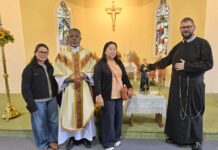

From 19 to 26 April, jubilee celebrations were held in Muro Lucano, the birthplace of Saint Gerard Majella, marking the tercentenary of his birth. The arrival of the reliquary containing the statue of the saint, which preserves an important relic, officially opened the pilgrimage. It was fitting that this journey began in Muro itself. Its arrival stirred great enthusiasm among the people of this Lucanian town, already known for their deep devotion to their distinguished fellow citizen.
Coming from the Sanctuary of Materdomini, the reliquary—carried by the parish priest, Fr. Tomás, together with a representative of a local association—first reached Ponte Giacoia, where it was welcomed with great fervor. On Sunday, as scheduled, it entered triumphantly into the historic center, following the traditional procession routes and stopping at places associated with Saint Gerard. Placed in the central church of Sant’Andrea, it became the focus of constant veneration, drawing a steady stream of pilgrims who gathered for prayer and took part in the various celebrations organized by the parish priest and his assistants. A prayer vigil brought together the faithful of Muro and pilgrims from nearby villages.


On Tuesday the 21st, Fr. Vincenzo La Mendola began a three-day series of reflections, remaining available throughout the day for the Sacrament of Penance, which was sought by many of the faithful. He also conveyed greetings from the entire Redemptorist Province of Southern Europe and its Provincial Superior, reaffirming the close bond between the Redemptorists and the community of Muro. During these days, he recalled significant figures connected with the history of Muro and the Congregation, including the Redemptorist bishops Pietro Ignazio and Vincenzo Marolda, and Fr. Giuseppe Lordi, former Rector Major of the Institute. In the morning, he also presided over a celebration for the sick, organized by UNITALSI, during which the Anointing of the Sick was administered.
On Wednesday the 22nd, the image of Saint Gerard was brought to Capodigiano, where it was warmly received by a large crowd. The residents decorated the streets and prepared a floral display with Eucharistic motifs in front of the chapel. The celebration was presided over by Fr. Antonio Savone, Episcopal Vicar and parish priest of the Cathedral of Potenza. In the afternoon, catechesis was offered, followed by the blessing of mothers and children.
The following day, groups of students from local schools came in procession before the image, receiving catechesis on the life and message of Saint Gerard. Later, the pilgrimage returned to Ponte Giacoia. Despite bad weather, the faithful participated in large numbers in the procession and the Eucharistic celebration, presided over by Fr. Vincenzo, at the parish church dedicated to Saint Gerard—the only one in the area bearing his name. That evening, the reliquary was brought back to the center of Muro, followed by a moving torchlight procession to the cathedral, where many gathered for catechesis and a final blessing.
Thursday the 24th marked the high point of the celebrations, drawing thousands of faithful, Church authorities, and representatives of civil institutions. The opening ceremony took place near the small church housing the baptistery where Saint Gerard was baptized on 23 April 1726. From there, a long procession moved its way through the streets of the historic center to the cathedral, where a solemn concelebrated Eucharist was presided over by Cardinal Enrico Feroci. Particularly moving moments included the blessing of the baptismal water, the reading of the papal bull by Fr. José Conti, and the opening of the Holy Door. Despite the cold and strong winds, the square was filled with faithful who entered the cathedral with visible emotion.
Among those present were Archbishop Davide Carbonaro of Potenza, Archbishop Emeritus Salvatore Ligorio, and Archbishop Pasquale Cascio of Sant’Angelo dei Lombardi, as well as other bishops from the region. A large number of clergy, religious, and Redemptorist missionaries also took part, including Fr. Serafino Fiore, Rector of the Sanctuary of Materdomini.


The mayor of Muro Lucano, Giovanni Setaro, welcomed civil authorities from across the Basilicata region, along with delegations from other areas, including Frosinone—a city twinned with Muro in honor of Saint Gerard. Both communities share a deep spiritual and cultural bond rooted in their devotion to the saint.
The participation of the faithful was remarkable. In his homily, Cardinal Feroci reflected on the essential aspects of Saint Gerard’s life, highlighting the enduring relevance of his message as a guide for Christians today. Archbishop Carbonaro also expressed gratitude to all those present and emphasized the importance of the Jubilee for the Church in Basilicata.
The entire event was marked by deep devotion and careful organization, thanks to the efforts of the Jubilee Committee, Civil Protection volunteers, and the National Association of Carabinieri, who ensured safety and order.
The celebrations continue in the days ahead, with times of prayer, youth vigils, and further stages of the pilgrimage. On 25 April, the reliquary will be transferred to the Church of San Marco before continuing on to Vietri di Potenza.
With the inauguration of the Year of St Gerard, Muro Lucano and the wider region of Basilicata begin a prolonged period of liturgical celebrations and pastoral initiatives, involving numerous communities across southern Italy and beyond. The pilgrimage will even extend internationally, including a planned stop in Poland.
In this way, Saint Gerard returns to his hometown, welcomed as one of its own. His presence continues to inspire the faithful, who look to him as a model of holiness and a powerful intercessor in times of need. Muro Lucano, with its vibrant faith, once again confirms the enduring popularity of this humble Redemptorist saint, a central figure in the religious life and culture of southern Italy. His links to the religiosity and culture of the south are the subject of recent historiography, as demonstrated by the publication of an interesting work by Chiara Ponte, “San Gerardo Maiella tra storia e tradizione popolare” (Saint Gerard Maiella Between History and Popular Tradition), which enriches the bibliography on Saint Gerard, offering its original academic contribution.
Fr. Vincenzo La Mendola, C.Ss.R.