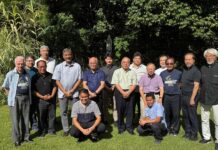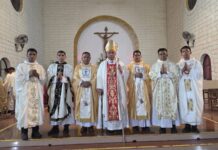

The Eparchial Bishop of Bratislava, Most Rev. Milan Lach, SJ, has appointed Father Miroslav Bujdoš, CSsR, as the new Protosyncellus—Vicar General—of the Greek Catholic Eparchy of Bratislava. The appointment was announced on April 10, 2026, Friday after Easter. Father Bujdoš is the second Protosyncellus in the history of the eparchy, founded eighteen years ago.
Who is Father Miroslav Bujdoš?
Miroslav Bujdoš, CSsR, is 42 years old and has been a priest for 16 years. The new protosyncellus was born on February 28, 1984, and hails from Stropkov. After completing his secondary school education at St. John Chrysostom High School in Humenné, he entered the Congregation of the Most Holy Redeemer in 2002; in 2009, he took perpetual vows.
From 2002 to 2010, he studied philosophy and theology at the Pontifical John Paul II University in Kraków and Tuchów, Poland. He was ordained a priest on May 23, 2010, in the Minor Basilica of the Descent of the Holy Spirit in Michalovce. He subsequently served as chaplain at the parish of Our Lady of Perpetual Help in Stará Ľubovňa. In 2015, he was appointed vice-provincial treasurer and a member of the Redemptorist community in Michalovce. Between 2015 and 2017, he attended the formation school in Kraków. Throughout his priestly ordination, he worked as a missionary in the so-called “popular” parish and school missions and was also responsible for vocations ministry. He is a co-founder of the Missions in Schools project.
From 2019 to 2022 he attended the Pontifical Alphonsian Academy in Rome, concluding his studies with a licentiate in moral theology.
Since January 2023, he has been Vice-Provincial Superior (proto-hegumen) of the Redemptorists’ Vice-Province of Michalovce. With the consent of Superior General Fr. Rogério Gomes CSsR in Rome, Miroslav Bujdoš CSsR has been appointed protosyncellus – vicar General. In the now eighteen-year history of the Eparchy of Bratislava, Father Miroslav Bujdoš CSsR is the second protosyncellus; he succeeds Fr. Vladimír Skyba (2008–2026) in this office.
Fr. Bujdoš is fluent in Italian and Polish, and can also express himself in Ukrainian.
The protosyncellus – Vicar General
The protosyncellus (Latin: protosyncellus) corresponds to the Vicar General in the Latin Church. According to the Code of Canons of the Eastern Churches (cf. canons 245–251), he is the bishop’s closest collaborator and has the task of assisting the eparchial bishop in the governance of the entire eparchy (can. 245); he can issue decisions and provisions, except those reserved directly to the bishop; he represents the bishop in his absence or by his delegation; and he oversees the functioning of individual ecclesiastical institutions and the clergy.
The protosyncellus is appointed by the eparchial bishop and has the same power of governance as the eparchial bishop (can. 248). The protosyncellus exercises executive power in the bishop’s name throughout the eparchy (similarly to the vicar general in the Latin Church).
(Source : https://www.grkatba.sk)

“Missionary enthusiasm and reaching out to people.”
Interview with the new protosynkel of the Eparchy of Bratislava, Redemptorist Fr. Miroslav Bujdoš, by Stanislav Gábor — Eparchy of Bratislava
“Father Miroslav, how did you feel when you were appointed the new protosyncellus of the Eparchy of Bratislava?”
Bishop Milan first spoke to me about it on the sidewalk in front of Bratislava Cathedral, shortly before the beginning of his installation as eparchial bishop. You can imagine what was swirling in my head throughout the celebration. But I’ll immediately add that one of the things life in the monastery taught me was to be available. My human worries, confusion, and uncertainties thus alternated with a clear answer: to be available.
Three years ago, when my confreres elected me Vice-Provincial Superior, I shortly thereafter met personally with the Superior General of the Redemptorists in Rome, who said to me: “Father Miro, it’s time to give back to the Church what she has placed in you since your baptism.” He was right. These are strong arguments for me too.
As a religious priest, you have sixteen years of pastoral experience; furthermore, since January 2023, as Vice-Provincial Superior (proto-hegumen), you have been leading the Greek Catholic Redemptorists of the Vice-Province of Michalovce. You have led numerous popular missions in parishes and are also a co-founder of the “Missions in Schools” project. Based on your experience, what pastoral priorities would you like to emphasize in your ministry?
Being close to people. But not only that. For a long time, I’ve made it my goal to discover and seek the good in people. I even try in the confessional. It seems to me that humanity is losing this ability and is suffering incredibly as a result. The missions themselves, each time in a new parish, have taught me that we shouldn’t wait for new opportunities, somewhere in the comfort of our own monastery, but that opportunities must be created and sought, and we must reach out to the people. Years ago, a confrere of mine and I decided not to join those who complain about the lack of young people. At a certain point, we stopped waiting for them to come to us and decided to go to them. And where are all the children and young people? – In schools. We started with two of us, then a third confrere joined, sometimes there were four or five Redemptorists, and even young leaders joined us. We launched the “Missions in Schools” project. So, to the question: “What should we emphasize in our ministry?”, the answer is: “People.” Creating opportunities to get closer to people, to understand them, to be available to them.
The Congregation of the Most Holy Redeemer (Redemptorists)—although of Latin origin—has put down deep roots in the Greek Catholic Church in Slovakia, as well as abroad. Your congregation also gave our local Church the blessed martyr Metod Dominik Trčka. What is the main charism of your congregation, and how do you see its application in today’s secularized world, particularly in the diaspora?
The purpose of our Congregation is to follow the example of Jesus Christ by proclaiming the Word of God. Our constitutions teach us to do so with missionary enthusiasm and by meeting the urgent pastoral needs of people. These two attributes have guided me throughout my life: missionary enthusiasm and reaching out.
You mention the diaspora environment. Last November, I visited our Greek Catholics in the parish of Prievidza. The family spirit and close relationships I found there are enviable even for large parishes. Sometimes, being in a small community, close to one another and, what’s more, without anonymity, is a privilege. Family spirit is a privilege of such a parish. I’ve been among the Greek Catholics in Trnava several times and have been amazed at how those people want to be together, pray together, and grow together in faith. Isn’t there hope and a future in this?
I remember Blessed Methodius: he renounced his homeland, his language, his liturgical rite… and went to eastern Slovakia, to Stropkov, where poverty reigned, not only materially but also spiritually. He possessed missionary enthusiasm, and he addressed urgent pastoral needs. He fulfilled the legacy of the Constitutions—the rules of Redemptorist religious life. I must also mention the Servant of God Fr. Ján Ivan Mastiliak, CSsR, who was one of the pillars of the renewal of the Greek Catholic Church in 1968. More than thirty religious and eparchial priests studied secretly with him. I do not deny that I am proud of my confrere predecessors—martyrs, confessors—and I wish to continue their legacy.
In his service we wish: Mnohaja i blahaja lita!