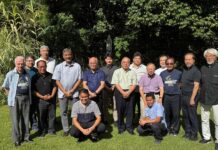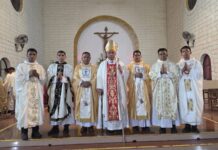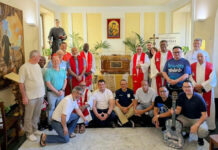

With the firm intention of breaking away from daily routine and reconnecting with God and Redemptorist life, a group of 11 confreres from the Mother Province of Perpetuo Socorro (Central America and the Caribbean) gathered from May 4th to 8th at the Christ the Redeemer Retreat House in Aguas Buenas, Puerto Rico. In the context of Easter and in response to the Congregation’s invitation for this year 2026, the religious experienced a time of grace and fraternity focused on deepening their Christian leadership. Due to the logistical complexity of a province spanning 11 countries, this experience in Puerto Rico culminates a series of regional retreats also held in Haiti, Panama, and El Salvador.
The article by Fr. Maximo De Los Santos Otaño, C.Ss.R.
The annual retreat for consecrated persons is more than necessary because it helps us detach ourselves from ordinary life, from daily chores, to reconnect with God and our Redemptorist life. Following this logic, the Redemptorists of the Mother of Perpetual Help Province, in the context of Easter, during the months of April and May, experienced retreats in various places (Haiti, Panama, El Salvador, and finally Puerto Rico). Since we are a province comprising 11 countries, it is logistically challenging to plan a retreat in a single country, as a popular saying goes, “there are no beds for so many people.” This latest retreat took place from May 4th to 8th at our Cristo Redentor Retreat House, located in Aguas Buenas, Puerto Rico. Eleven confreres who work in Puerto Rico, Cuba, the Dominican Republic, and Central America participated. It was truly a time of grace. A time to go to Bethany as a place of rest to seek God’s will. A time to grow in the spirit of unity to glimpse the missionary horizon together.

These were days of sharing, marked by closeness and simplicity, and evangelical brotherhood, as well as reflection and exploration of leadership, a theme the Congregation invites us to work on in this year 2026. The speaker told us that we Redemptorists are asked to be leaders, and leaders who follow Jesus. We must recognize this, because wherever we are, we are called to be leaders. A key word of the retreat was HARMONY. Harmony is the coherence of four elements: what we say, what we think, what we feel, and what we do.
The retreat exercises were led by Sister Blanca Cecilia Cely Ruiz, a Colombian nun of the Society of Mary. She holds a doctorate in theology with a specialization in Theological Anthropology and a doctorate in bioethics from the Pontifical University Javeriana. She is a professor at CELAM, coordinator of the Plenitud CLAR Commission, and Vicar for Religious Life of the Archdiocese of Bogotá. She began by inviting us to remember the brothers who were present last year but not this year, some of whom have passed away, such as Father Damián Wall, as well as Fathers Antonio and José Rached, who are absent for health reasons.
From day one, the director provided us with lumber, tools, and paint to build a house, our home. In the background was the text from Psalm 127:3: ” Unless the Lord builds the house, those who build it labour in vain.”
Furthermore, as a good theological anthropologist, she urged us to consider that every process that begins requires time and perseverance, since we are not yet complete; hence the importance of continuing to configure ourselves to the person of Jesus.
On the second day, he invited us to recognize that each person is responsible for their thoughts and actions. We must not allow ourselves to be influenced by affections and emotions; in the retreat and in our lives, the protagonist is the Spirit. It is the Spirit who shapes the face of the Church and the relational fabric that makes communion possible. The encounter can be a unique opportunity for conversion, a new birth. Newness is created by the Spirit, and therefore the key is: LISTEN TO HIM.

To return to the essential and let love build us. And speaking of love, we were invited to undertake a journey that consists of: looking with faith, looking with realism, looking at everyone, looking with everyone, looking creatively; looking consciously of the Gift received, where prayer plays an important and essential role.
In this sense, we have been invited to build the house of redemption. Seeing the welcome in the walls: who enters and how do we welcome them? Does our house have windows open to the most abandoned? Our house has cracks (fragility) where redemption must enter. Our cracks have flaws, such as lack of communication, fatigue, individualism; it’s not a matter of hiding them, but of recognizing that through those cracks the light of the Copious Redemption enters, because where human weakness abounds, the grace of Redemption overflows.
In this journey, we were introduced to the topic of leadership from the perspective of SHEMA—LISTENING. Avoiding harsh judgments. We were given the example of Ubuntu, a practice from an African tribe according to which, if someone makes a mistake, the community calls them out. And everyone begins to tell them the good things, the qualities they possess. The mistake is not mentioned. Today, more than ever, there is a need for spiritually transformative leadership, because in our lives, there are many references that link leadership to the economic, business, or entrepreneurial environment. These connections reinforce the idea that the leader is the person who has achieved success. However, leadership, from a theological perspective, is understood as an ACTION and a practice that arises from a received Gift, that is, it is discovered in the ability of every human being to listen to their inner self. Vocation and Gift that nourish each other, that spring from a life of prayer. And in fact, the Redemptorist leader is deeply touched because he is capable of FEELING COMPASSION.
For us Redemptorists, who often face heartbreaking social realities (poverty, violence), leadership requires a “contemplative serenity,” the ability to hear this cry in one’s community and among the people.
Redemptorist leadership is exercised through the preaching of the Word that liberates and brings peace. In the midst of community conflicts or institutional crises, the Redemptorist leader must be the bearer of a word that brings Plentiful Redemption, not one that increases chaos. A leader is one who works for the kingdom of God. A leader of Jesus works for justice. He works for peace.
If there is justice, there is peace, and if there is peace, there is unity. A Redemptorist must work for justice, peace, and unity, starting from his own home. To do this, naturally, we must ask ourselves: Am I happy? What do I need to revitalize myself? With these questions, after listening to the song “Today Can Be Your Great Day” by Joan Manuel Serrat, we were invited to harmony. Inner harmony, often called inner peace or emotional balance, is a state of well-being because thoughts and emotions are aligned. Achieving inner harmony can lead to better internal balance, better mental health, and a fuller life. In biblical terms, this means that God expects us all to have a single feeling.
We have been invited to never tire of SOWING. Sowing is an art that requires knowledge of the characteristics of the soil, climate variations, but above all, the potential of the seeds. The essential is always found, primarily, in the germinal state. Sowing is demanding, and even more so if you intend to sow at night. Our mission is to be Sowers as transformative leaders, nourished by an experience of prayer.
On the last day, we were invited to contemplate the little house we had built over the course of the week and our name, our very name. In addition to identifying the elements that make us authentic children of Saint Alphonsus, we also explore our spiritual genealogy. Indeed, in Redemptorist DNA, we see the leadership that comes from closeness. An authentic leader is a communicator of hope. In the gene of closeness, KINDNESS appears as authority. A true son of Alphonsus is not distinguished by his cry, but by his kindness. Being true children of Saint Alphonsus means avoiding extremes. A true son always seeks mercy. His question will always be: what will lead this person to encounter the Redeemer?
On this journey, we have been invited to embrace closeness and balance. Because we can be AAA people who: Enliven, Accompany, and Love. This is why vital integration is important on a personal level: head, heart, and hands. At the provincial level, a Personal Project. With the logic of community: Participation, a sense of belonging, and patience. On a personal level, we need coherence between theory and practice. We must combine work and prayer; we must be signs that need no explanation. To do and receive good, healing, and giving life.
Finally, the little house we built during the week was brought to the Mass on the last day to be presented at the offertory, along with a rose for our Mother of Perpetual Help. Naturally, these were days of prayer and rest in the Lord through the celebration of fraternity, accompanied by the weekly Bible readings that encouraged fraternal love and evangelical friendship among the brothers.