
An article on Brother Wenceslaus, a Redemptorist Brother, who was the brother of St. John Neumann
Of the three male children of Agnes and Philip Neumann, one of whom died in infancy, the youngest was Wenceslaus (aka Wenzel), about whom little is known. This is a consequence partly of remaining in the shadow of his older brother John, six years his senior, who would go on to become the first professed Redemptorist in the United States, fourth Bishop of Philadelphia, and America’s first male saint.
Wenzel Neumann was also born on September 4, 1817, in the family home in Prachatitz, in what is today the Czech Republic. Despite their age difference, his elder brother was an ever-interested guide and friend. They shared a mutual love of botany and the two loved to wonder through the fields and woods surrounding their town. The two became separated when John began his studies in the gymnasium in Budweis, where he eventually matriculated to the diocesan seminary. John’s letters home reflect a simple relationship, sometimes accompanied by gifts. John would send his brother (“the little rascal Wenzel”) a book on biblical history, pens for writing his examinations, or butterfly specimens. During his seminary studies, the two encouraged one another in holiness.

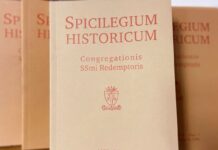
Unlike John, Wenzel did not pursue higher studies even though his family could afford it. Likely he was employed in his father’s hosiery business and helped him in church affairs. Insofar as his father strictly forbid any of his family to reply to John’s letters from America, Wenzel lost touch with his brother. Yet John’s letters home, recently translated for the Spicilegium Historicum by Professor Rudolf Svoboda of the University of Budweis, give new insights into their relationship and the prospect of reuniting across the Atlantic.
There are few direct letters between the two brothers in the wake of John’s emigration to America. Instead, Wenzel is mentioned in letters his brother wrote to others and eventually news got back to him through these interlocutors. Thus, a few weeks after he was ordained in New York, word arrived in Budweis of the blessed event. John’s fellow seminarian, Adalbert Schmid, who would go on to become a priest of Budweis, wrote Wenzel (July 20, 1836) about the plan of John’s ministry. He suggested to Wenzel that “there will certainly be more individuals in the Diocese of Budweis who will follow your brother, and you could join them.”
This thought did not leave him. In an 1834 letter to his parents from Prague, John speculates that if Wenzel “has not yet gone abroad,” he should write to him. The saintly brother knew of Wenzel’s own hopes to travel to America—an open possibility that his parents were already aware of. John sailed for America in 1836 and was almost immediately ordained for service in New York. The following year, he called for his younger brother to join him, but nothing transpired, and John sank into a low state.
Wenzel decided finally to join his brother and left Le Havre on August 1, 1839, aboard the ship Republic. Writing to his parents, he remarked that midway through the journey the vessel encountered a thick fog so that for days the bell was rung constantly in order to avoid ramming other ships. Despite turbulent seas, all of the books and religious goods—including a monstrance—arrived safely in New York Harbor. It was not until September 25, 1839, that Wenzel appeared at the door of John’s makeshift rectory at North Bush, New York. He was a tonic for loneliness, but he also stepped in to alleviate domestic chores, carpentry, and teaching duties with newly catechized children. While there he patiently carved some of the statuary for the chapel and the two surviving carvings now rest in a little museum associated with the chapel in Williamsburg, New York, which Father Neumann had erected. The brother he knew was becoming the brother he needed, but a gnawing urge for community led John to join the Redemptorists in Pittsburgh. He professed vows on January 16, 1842. For his part, Wenzel, felt tethered to his brother’s vocation, though not as a priest. Staying behind to arrange for the transfer of his brother’s ministries, he moved on to Pittsburgh on November 13, 1840, to begin his own novitiate.
It was during this time that he did a considerable amount of traveling. In May 1841 he came to Baltimore with his brother and the following year he moved to Baltimore briefly. In July 1842 he was sent to Norwalk, Ohio, where the early Redemptorist pioneers established St. Alphonsus Church. In 1843 he was sent to Rochester and in 1844 he could be found at St. Peter’s in Philadelphia, arriving just in time to witness the anti-Catholic riots in that city. He pronounced his vows as a Redemptorist brother on September 8, 1845, in Baltimore at the Redemptorists’ Church of St. James the Less. His first assignment was to be the cook at St. Mary’s Catholic colony, a short-lived experiment in the hinterlands of central Pennsylvania. He then moved to Pittsburgh (1848) and finally to Detroit (1849) where he remained for the next decade.
Brother Wenzel developed religious life into a quiet routine, but the “little rascal” grew in grace. He was attentive to community prayer. When he was named Bishop of Philadelphia in the spring of 1852, Wenzel was given permission to leave his community in Detroit and travel to Baltimore for the consecration. Out of humility, he declined to go. It would be seven years before the two would meet again, this time in Pittsburgh, in November 1859, when then Bishop Neumann conferred minor orders on 28 clerics including their nephew, John Berger. This was also their last meeting. The holy bishop would die exactly two months later within eyeshot of the grand cathedral he was then building in Philadelphia.
In 1861, Brother Wenceslaus was among the pioneer Redemptorists at the new foundation of St. Michael’s in Chicago, the present headquarters of the Denver Province, and his name appears on the incorporation documents for the Redemptorists of Chicago. In February 1866, he was transferred to the community at St. Alphonsus in New Orleans, where he would spend the remainder of his days. For over thirty years he was the sacristan of the smaller French church of Notre Dame de Bon Secours that was in the care of the Redemptorists for many years. Nearly every day he made his way to ring the bell for the six o’clock Angelus, open the church, lay out the vestments, and decorate and prepare the altar. He left New Orleans only once, under obedience in 1886, to testify before the tribunal in Philadelphia for the canonization cause of his brother. His testimony was taken and he returned at once.
Throughout his tenure in New Orleans, he passed the daily exercises without fanfare and was devoted to the rhythms of religious life without care or complaint. This is the reason why, for all his time there, he is spoken of only a handful of times in the house annals. The chronicler spoke of his hernia in the aftermath of Christmas 1886 and subsequent intestinal trouble the following January, but he hardly merits further mention. Others would later recall how invested he was in keeping a green house near Notre Dame so as to be able to collect flowers for the altar. One brother who lived with him, Brother James Passmore, remarked on how any discussion that turned to botany would elicit a marked change in his demeanor, as if he came alive or woke from an otherwise reserved state of being. There was very little in his own room at the time of his death, which occurred as quietly as he lived.
After receiving the last sacraments and renewing his vows, Brother Wenceslaus died at one o’clock in the morning of April 11, 1896, age 78. He had continued his duties up until the day before he died, when he suffered a slight stroke. The neighborhood realized something was amiss because they did not hear the familiar Angelus bell. Father Joseph Firle, the rector at the time, wrote of Brother Wenzel’s last moments: “he fell into a gentle sleep and remained so until he died.” He was initially buried with his Redemptorist confreres in St. Joseph Cemetery #1, but on February 16, 1906, his remains were translated to the sanctuary of the Church of St. Mary’s Assumption in New Orleans, steps away from the shrine of Blessed Francis Seelos, where they now repose.
Mr. Patrick Hayes, Ph.D.
Archivist,
Redemptorist Archives, Philadelphia