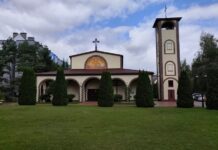

On the feast day of Saint Gerard Majella, October 16, the Redemptorist community gathered at the Shrine of Perpetual Help in Rome to celebrate the memory of the saint from Muro Lucano, a model of simple and concrete holiness. The Holy Mass was presided over by Father Ivel Mendanha CSsR, general consultor of the Congregation of the Most Holy Redeemer, who in his homily presented Saint Gerard as an authentic missionary of hope in the footsteps of the Redeemer.
Fr. Mendanha recalled how, during the preparatory Triduum for the feast, the community meditated on Saint Gerard as a pilgrim of hope, then as a missionary of hope, until reflecting on the sources of hope in his life. “Today,” he stated, “we contemplate Saint Gerard in light of the theme of our six-year term, Missionaries of Hope in the Footsteps of the Redeemer, recognizing in him a living example of how faith can be transformed into active charity.”


The homily intertwined the spirituality of St. Gerard with the universal message of the Church. Fr. Ivel cited the Holy Year Bull of the late Pope Francis, which calls Christians to be “tangible signs of hope for our brothers and sisters experiencing difficulties of any kind,” and the recent Apostolic Exhortation Delixit Te (I have loved you) by the Holy Father Leo XVI, which places love for the poor at the center of the Christian experience. “Charity,” Mendanha recalled, “is the ardent heart of the Church’s mission. When the Church bends down to care for the poor, she assumes her highest posture.”
Through concrete episodes from the saint’s life, Fr. Ivel demonstrated how Gerard Majella embodied this evangelical sign of giving. Born into a poor family, he experienced firsthand the daily toil of the humblest and transformed his experience into an extraordinary vocation of service. A famous episode is the one in which he donated his coat to a beggar, a gesture that reveals his instinctive compassion and trust in Providence. During the famine of 1755, his generosity became almost legendary: no one, witnesses recount, returned empty-handed to anyone who knocked on the community’s door.


“Gerardo,” Father Mendanha emphasized, “was a tangible sign of hope for the poor and marginalized. In his life, the Church was bending down to care for the poor and through his ministry as a Missionary Redemptorist Brother the Congregation and the Church was assuming her highest posture, namely sanctity in caring for the poor.
The celebrant concluded by inviting those present to follow the path traced by Saint Gerard: “Let us learn from him to love the crucified Lord, to adore with ardent hearts in the Eucharist, to entrust ourselves to Mary, and to draw near with love to the poor and abandoned. This is the most real and simple way to be missionaries of hope in the footsteps of the Redeemer.”
At the conclusion of the celebration, Fr. Ivel Mendanha blessed those present with the reliquary of Saint Gerard, inviting everyone to cherish the saint’s example in their hearts. Immediately afterward, the faithful were able to personally venerate the relics, entrusting their intentions to the patron saint in silent prayer.
Also find below the complete homily of Fr. Ivel Mendanha CSsR.
Homily of Fr. Ivel Mendanha on the Feast of St Gerard: A Missionary of Hope in the Footsteps of the Redeemer
Having reflected during these days of Triduum on St Gerard as a Pilgrim of Hope, then as a Missionary of Hope and finally on the sources of Hope in his life we reflect today on his feast day on the theme of our sexennium, the six years that we are celebrating in the Congregation, Missionaries of Hope in the Footsteps of the Redeemer and we see how St Gerard is for each of us Redemptorists and for all people in this this Jubilee year an example of one who was a Pilgrim Missionary of Hope in the footsteps of the Redeemer.
Our late Holy Father Pope Francis in the Bull for the Holy Year said, “During the Holy Year, we are called to be tangible signs of hope for those of our brothers and sisters who experience hardships of any kind.”
Our Present Holy Father, Pope Leo XIV just a few days ago published his very first Apostolic Exhortation entitled “Delixit Te” (I have loved you). In this Apostolic Exhortation Pope Leo says, “The desire of my beloved predecessor that all Christians come to appreciate the close connection between Christ’s love and his summons to care for the poor. I too consider it essential to insist on this path to holiness”
The exhortation emphasizes, above all, how essential the poor are to Christian life. Charitable works, Pope Leo writes, are “the burning heart of the Church’s mission” (15). In the Incarnation, Christ became poor in the flesh that we might become rich in God (18; see 2 Cor. 8:9), and Christians are called into the same humble descent, touching the suffering flesh of the least among us that we might touch the suffering flesh of Christ (48, 49, 119). And one needn’t limit this, Leo clarifies, to material poverty: “In fact, there are many forms of poverty: the poverty of those who lack material means of subsistence, the poverty of those who are socially marginalized and lack the means to give voice to their dignity and abilities, moral and spiritual poverty, cultural poverty, the poverty of those who find themselves in a condition of personal or social weakness or fragility, the poverty of those who have no rights, no space, no freedom” (9).
Pope Leo calls for both love for the Lord and love for the poor (5, 8), an extension of the “distinct yet inseparable” loves for God and neighbour (26). He likewise writes of both faith and social action (40), both doctrinal rigor and mercy (48), both prayer and work (53), both piety and dedication to others (71), both proclaiming the Gospel and meeting material needs (77). “The monastic tradition,” he writes, “teaches us that prayer and charity, silence and service, cells and hospitals form a single spiritual fabric” (58).
In paragraph 79, Leo beautifully sums up this both/and approach—and indeed the whole history of the Church’s love for the poor, from the Old Testament prophets through Pope Francis—with a striking paradox: “When the Church bends down to care for the poor, she assumes her highest posture.”
We can say that in St Gerard, the Pilgrim Missionary of Hope, the Church was bending down to care for the poor and through his ministry as a Missionary Redemptorist Brother the Congregation and the Church was assuming her highest posture, namely sanctity in caring for the poor.
St Gerard was a tangible sign of hope especially to the poor and needy, the very abandoned of his time. He was a missionary of Hope to the poor in the footsteps of the Redeemer. The immediate and generous solidarity that Gerard demonstrated with the needy poor is a basic aspect of his spirituality. The basis for this solidarity lies in the fact that he was born into a poor family and from a very early age he knew personally the many daily hardships that a poor family has to endure. However, this solidarity with the poor is based more on his love for his Redeemer who chose specifically to identify with the abandoned poor.
This love for the poor was something Gerard had even as a young adolescent. There is the story about the new coat that his uncle had given him and which he gave to a poor man. Seeing his young nephew so weak and frail Gerard’s uncle gave him a new coat to keep him warm. But hardly had Gerard left the house that he met an old man so cold that he immediately gave him the coat. When his uncle came to hear of this he vented his anger on Gerard for giving away so new and expensive a coat. Gerard’s reply was, “I gave it to another person more needy than me.” Truly, a Missionary of Hope even as a young man.
True charity results in gestures and words that always arise in response to the needs of others. It is being faithful to the example of Christ who came to encounter human beings: he incarnated himself in the concrete situation of the needs of his fellow human beings so as to provide a response that would be an effective help and assistance to them. Charity therefore always is a result of sincerity and respect. Gerard always made sure to avoid any show or the dramatic in his charity thus being faithful to the words of Christ, “Be careful not to do your acts of righteousness before men, to be seen by them…But when you give to the needy, do not let your left hand know what your right hand is doing.” (Mt:1, 3). Gerard knew well that the poor were the poor of Christ and that when we respond with sincerity to their needs, we are the first to be enriched by them. This respectful and generous love for the poor is described as being “a natural inclination towards the poor”, underlining “that he was very compassionate with all and specially with the poor, for whom he had a special softness.”
Gerard reached out not just to the poor but also to the poor who were sick and infirm as well carrying for them medicines from the community infirmary. He was especially very attentive and caring towards the disconsolate widows and aged spinsters who could very easily be deceived due to their simplicity and honesty. Gerard made many visits to the poor who were sick in Naples: “Gerard was often found in the corridors of the Hospital of the Incurables, one with those poor sick ones, talking to them about God and inviting them to accept and carry the cross that the Lord have sent them as well as to offer God all the pains and sufferings that they had to bear. He always filled them with hope and left them all consoled. On seeing him the suffering poor sick in the hospital would rejoice and say, ‘Our Father, you console us. We want you to remain always with us. Do not ever leave us, stay with us always!’
He was in a sense “passionate” in concretising his availability in giving himself to his brothers and sisters. It was observed that “He especially liked to be tired, in a way that he would never lose any time. When he did not have anything to do, he would seek to help others with their duties… When it was time to bake bread for the community, he would do the work of four. He would constantly tell his confreres, Let me do it, go and rest yourselves! He was always recollected and united to God, very often with eyes raised to heaven, more or less in a state of having transcended the senses.”
His charity would give rise to miracles when he went out to meet the poor. The popular folklore has above all underlined this aspect especially during the harsh winter of 1755. Caione also witnesses to this: “due to the extreme scarcity because of the severe winter, over 120 poor people would turn up at our doors every morning. And here one cannot express sufficiently the great charity with which Gerard would care for and assist them in their misery. He would do everything for everyone, he would console some with his musical words about heaven, instruct others on things of the faith, give them little pious talks and then finally give them something to satisfy their needs and send them off doubly consoled.”
Gerard demonstrated an amazing generosity and love to the poor during the harsh winter of 1755. There is a remarkable story about the shortage of bread and Gerard’s intercessory powers. “There was once present a certain person of some notable ranking but not having enough due to the famine. He was feeling embarrassed to come forward to ask for bread. One of the little boys known to the community informed Gerard about the situation. Gerard replied ‘Oh my son, why have you come so late? I have already given away everything!’ But then reflecting a bit, he turned and went into the house, and seemed to draw out of his chest a loaf of bread so fresh baked and hot that it just came out of the oven… In that harsh winter of famine in Caposele no one seemed to go away hungry who came to knock at door of the community, thanks to the efforts of Gerard.”
Gerard used all his talents at the service of the poor and at the service of his own confreres in the community especially the elderly. He used to sing, dance, narrate stories during recreation and was the centre of the community joy and laughter always reaching out to those in need. The Tailors room in the community was a favourite place for all to go to and not just to get their clothes and habits stitched and darned but also to hear a funny story or share a joke and a moment of laughter.
All of this points to the fact that Gerard was connected to people in a way that flows from the gift of the Spirit. The Spirit of Jesus which enabled him to live the Gospel joyfully. He truly was a sign and became a sign of hope to the poor and abandoned in the footsteps of the Redeemer.
We learn from this amazing Saint, Saint Gerard, who lived for just 6 years in the Redemptorist Congregation that one can be so united with Jesus and his blessed Mother that one learns to grow into being more like them in love for one’s neighbour and especially the poor. True holiness and life lived in Jesus is always reflected in a deep love for the poor and abandoned, the little ones, “whatsoever you do to the least of my brothers and sisters you do unto me.”
Delixit Te, I have loved You, words of the Lord to a very poor Christian community must be our own words, they were the words of St Gerard himself as he lived them with love for the poor. Like St Gerard, As we contemplate Christ’s love, I quote from Delixit Te “we too are inspired to be more attentive to the sufferings and needs of others, and confirmed in our efforts to share in his work of liberation as instruments for the spread of his love.”
May all of us on this the feast day of our Beloved Saint Gerard learn from him to love the Crucified Lord, to adore with love the Lord in the Most Holy Eucharist, to have a filial love for Our Blessed Mother and to reach out with love to the poor and abandoned. This is a real and yet simple, a true but holy way of being Missionaries of Hope following in the footsteps of the Redeemer. Gerard shows us the way of Hope through a life of love for the poor. Amen.