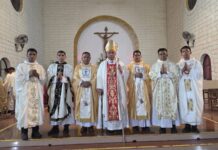

On Thursday the 20th of November 2025 at Pontifical Gregorian University in Rome Fr. Selwin Anthony Colaco, C.Ss.R. of the Vice Province of Majella and a member of the Collegio Maggiore at Casa San Alfonso in Rome defended his doctoral thesis in Fundamental Theology. Fr Selwin wrote this doctoral thesis in Italian and defended the same in Italian. The title of the Thesis was: ‘Throw open the windows.’ Christianity in the public sphere in the thought of Joseph Ratzinger/Benedict XVI (“Spalancare le finestre”. Il cristianesimo nella sfera pubblica nell’orizzonte del pensiero di Joseph Ratzinger/Benedetto XVI)
The one-and-a-half-hour defence was presided by Fr. Nicolas Steevs S.J. Professor of Fundamental Theology. Fr. James Corkery S.J., was the moderator of the thesis and Fr. Aaron Pidel S.J. was the Censore of the defence. Fr. Selwin for half and hour presented his thesis and then Fr. Corkery examined him for half and hour and finally the Censore had a half hour to question the student as the Devil’s advocate for the thesis. At the end of the defence the commission met to decide on the defence and returned to state that Fr Selwin Anthony Colaco, C.Ss.R had successfully defended his doctoral thesis and had been conferred with the Title of Doctor of Sacred Theology at the Pontifical Gregorian University.


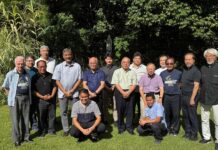
The Defence was attended by Fr. Rogério Gomes, C.Ss.R. Superior General, Fr. Joseph Ivel Mendanha, C.Ss.R. and Fr. Nicholas Ayouba, C.Ss.R. Consultors General, members of the Community of San Alfonso and the Collegio Maggiore in Rome.
After the very successful defence the new Doctor, Fr. Selwin A. Colaco, C.Ss.R. was interviewed by Scala News.
How did you choose the topic of your dissertation?
Fr. Selwin: In the summer of 2019, I arrived in Rome to pursue a Licentiate in Theology and was immediately struck by a profound culture shock. European life revealed sharp contrasts: the normalization of cigarette smoking among women, the unrestricted availability of alcohol, and the decriminalization of recreational marijuana. Equally troubling were subtle forms of discrimination against legal foreigners and the declining participation of Christians—both Catholic and Protestant—in church life. Most disorienting was the transformation of historic churches from sacred spaces into secular venues such as restaurants, museums, and libraries. This phenomenon seemed to embody a deeper identity crisis within Europe, a continent advancing steadily toward secularization and, in some respects, a revival of paganism. My concerns echoed those voiced by Professor Joseph Ratzinger in his 1959 lecture, where he anticipated this cultural trajectory. It was for this reason that I chose him as the dialogue partner for my doctoral thesis.
Modernity seems to exclude God from the public sphere. What are the points of encounter between religion and the interests of today’s society?
Fr. Selwin: The essential point of contact between Christianity and the secular world, as I perceive it—shaped, of course, by Ratzinger’s thought—is the human person. Whether atheist, agnostic, or believer, we are first and foremost human beings. Genuine dialogue must therefore adopt an anthropological perspective, grounded in the truth that every person is created in the image and likeness of God.
In a secular world, how can faith be promoted? How can the message of Christianity be preached effectively?
Fr. Selwin: Ratzinger urges the secular world to grasp the essence of Christianity: it is a religion of the Lògos, a faith inherently grounded in reason. Because of this intrinsic rationality, Christianity deserves its rightful place in the public forum, where its message can be understood and engaged by all.
How can Christianity communicate its message across diverse cultures?
Fr. Selwin: To engage meaningfully with diverse cultures, dialogue is indispensable, serving as the bridge between differing worldviews and traditions. For Ratzinger, however, dialogue is never synonymous with compromise or dilution of faith; it does not demand the abandonment of one’s religiosity, Christian philosophy, or values. Instead, it calls for a posture of confident affirmation, where believers articulate their convictions with clarity and respect, offering the richness of Christian thought as a constructive contribution to the common search for truth. In this way, dialogue becomes not a negotiation of identities but a genuine encounter, rooted in the dignity of the human person and animated by the conviction that faith, when expressed positively, can illuminate and enrich the cultural conversation rather than retreat from it.
How do you envision applying the insights from your research in your ministry?
Fr. Selwin: I come from a culture shaped by centuries of history, where India is often regarded as a spiritual and religious hub, home to a remarkable diversity of traditions and philosophies. In envisioning my future ministry within this context, I find Ratzinger’s concept of inter-culturality particularly compelling. Unlike mere inculturation, which can sometimes imply a superficial adaptation of faith to local customs, inter-culturality calls for a deeper engagement: a steadfast conviction in one’s own Christian faith, expressed with integrity, while entering into respectful dialogue with the rich religious traditions of India. It is an approach that seeks not assimilation but genuine encounter, affirming the truth of the Gospel while recognizing the dignity and wisdom present in other cultural and spiritual expressions. In this way, ministry becomes both a witness to faith and a bridge of understanding, fostering mutual enrichment in the shared pursuit of truth.


At the end of the defence, the newly declared Doctor in Fundamental Theology thanked the Lord for the graces given constantly, the late Pope Benedict XVI for being his inspiration, the Moderator of the Thesis, Fr James Corkery and the Commission of the defence. He thanked the Redemptorist Family led by Fr Rogério Gomes the Superior General for his presence, the members of the General Council, Rector and community of San Alfonso and the Collegio Maggiore for their presence as well as the many Redemptorists including the Vice Province of Majella who had helped him along his research.
Scala News wishes the new Doctor of Theology Fr. Selwin Anthony Colaco, C.Ss.R. all success in his academic and missionary apostolate.
Scala News