
The proclamation of Saint John Henry Newman as a Doctor of the Church and patron of the Urbaniana University has brought his gigantic figure back into the spotlight, sparking renewed interest in his writings and his biographical story, which was both complex and fascinating.
Among the many significant contacts in the Cardinal’s life is his relationship with Saint Alphonsus and the Redemptorists. Newman’s thought in its various aspects has been extensively studied in Italy since the 1960s by the theologian Professor Giovanni Velocci (1924-2016), author of several interesting contributions. Among these we recall: Newman the Mystic (Rome 1964); Newman at the Council (Alba 1966); Newman: the Problem of Conscience (Rome 1985); Newman: the Courage of Truth (Vatican City 2000); Prayer in Newman (Vatican City 2004). He collected his most important contributions in the volume Meeting Newman (Milan 2009). To these better-known titles are added numerous other essays, articles, reviews, conferences, and presentations at study days and conferences— around ninety pieces (e.g., E. Marcelli)—that made Fr. Velocci is one of the most respected scholars of the Oratorian Cardinal’s thought. Father Velocci’s passion for Newman was also fostered by his friendship with the community of the Vallicelli Oratory, which he frequented regularly during his stays in Rome.

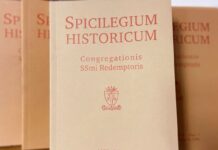
Father Giovanni studied the relationship between Newman and St. Alphonsus, publishing the fruit of his research in the final chapter of his text, The Spirituality of St. Alphonsus De Liguori (Edizioni Redentoristi, Rome 1989, pp. 257-278), with a preface by B. Häring, and republished with additions in his other books. The author, who had read and studied the works of the new Doctor of the Church from the original language editions, traced his first contact with St. Alphonsus to 1839, when Newman, studying the history of heresies in the early centuries of Christianity, began his journey of inner exploration that would lead to his subsequent entry into the Catholic Church. That same year, St. Alphonsus was canonized, an event that had universal resonance and did not go unnoticed in England. His meeting with Dr. Russell, an Irish priest who gave him a collection of De Liguori’s sacred discourses, was a propitious opportunity to come into contact with Alphonsus’s vast output: “Newman,” Velocci states, “did not find the exaggerations he feared, but rather serious and concrete doctrine presented with the mentality and warmth of an Italian.” And at the conclusion of reading Alphonsus’s homiletical texts, he wrote: “I only wish your Church were better known among us [Anglicans] thanks to books like this.” He noted: “There are many passages that could be considered legendary examples; but the essence is a simple, concrete, and impressive preaching of the great truths necessary for our salvation.” This “first encounter” with Saint Alphonsus was followed by others that marked his life as a pastor and theologian.

In 1846, he was in Rome, attending the Propaganda Fide University. At the same time, he was going through a difficult period of discernment, considering how to turn his life around and the possibility of entering a religious institute. Among those he considered was the Congregation of the Most Holy Redeemer, of which he, referring to its members, stated: “We hear great good things about them. […] People say they are like the Jesuits, but a little less militaristic.” He met with two Redemptorists from the community of Santa Maria in Monterone, asking for clarification on their life and mission. After that clarifying meeting, he concluded: “I fear they are not for us. […] The purpose of the Congregation is to teach and preach to the people of the countryside. […] The missions are its main task.” Finally, he chose the Oratory of St. Philip Neri, but did not forget the saints close to the spirituality of its Founder. Among them he favored St. Camillus and St. Alphonsus, “saints who we could call Oratorians, due to the close relationship they had with the Oratory,” and favored the publication of their biographies in English.
In 1847, during a trip to Naples, he stopped at the Oratory of the Gerolamini, where he listened with interest to several priests, including an 89-year-old priest who had known Saint Alphonsus. The testimony of the elderly Oratorian increased his esteem for the Saint, and a few days later, we find him in Pagani, praying before his body.
At another “critical” moment in his life, when the possibility of being appointed bishop of Liverpool or Nottingham arose, he was again supported by the example of Saint Alphonsus. He tried with all his might to avert what he considered a “danger,” preparing himself, like the holy bishop, to obey the Pope in any case.
The Redemptorists retraced their steps once again when a fellow Redemptorist, Fr. Coffin, left the Oratory to join their Congregation. For many years, he corresponded with him, supporting his publishing ventures. Coffin, in fact, translated the works of St. Alphonsus into English. Newman, however, did not believe it necessary to reprint them all, since many concepts were repetitive—he argued—but would have preferred a careful selection. St. Alphonsus, of whom he had read several biographies and some of his works, was considered by him to be the true reformer of morals, especially Italian ones, which, to a foreigner, coming to Italy for the first time, were deemed too lax, especially in matters of morality and liturgy. In a letter to Fr. Fargan, returning from a trip to Sicily, where he was shocked by the abuses of priests in the celebration of Mass, reaffirmed his appreciation for the Saint: “I think you can see in the customs and habits of Italians an illustration of the thought of Saint Alphonsus; for example, I believe you will better understand what it means to ‘misuse the Mass’, since you have been to Palermo.”
At another point in his life, in 1859, he drew on the thought of Saint Alphonsus when, following the publication of a “very bold” article in which he promoted and defended the role of the laity in the Church, he was subjected to violent attacks from clerical circles, especially from Rome, to the point that a trial was considered against him. It was on that occasion that he wrote confidentially to a friend: “We are no better than our Fathers. Think of Saint Joseph Calasanz, Saint Paul of the Cross, Saint Alphonsus, and my Saint Philip: they too were misunderstood by the authorities in Rome.” To Bishop T. J. Brown, who had defended him in Rome, before the Pope and the Superior General of the Jesuits, he gratefully expressed the spiritual motivations that had sustained him in those difficult times: “St. Alphonsus and St. Joseph Calasanz are my example and my lesson in bearing false judgments about me by men.” In his heated confrontations with some rigorist theological currents, he defended, with shrewd intelligence, some principles of Alphonsian morality, such as that of the restrictio mentalis, the object of heavy gratuitous accusations by Queen Victoria’s court preacher, dedicating a paragraph of his Apologia to it. On that occasion, over 500 English priests from various dioceses sent Newman their support and gratitude, for “having clearly elucidated the problem of truth, and for having given a correct interpretation of the doctrine of St. Alphonsus, of his agreement or disagreement with other writers, and of the meaning of the approval of his works given by the Holy See.”
With the intellectual honesty that distinguished him, even when he had to distance himself from some of Saint Alphonsus’s statements, mostly linked to the language and cultural context in which he lived, he did not hesitate to define him as “a saint who loves the truth and whose intercession I hope not to lose, even if in the case examined, I prefer another guide to his” and he was not afraid to declare that: “in the Morals of Saint Alphonsus there is nothing that can be censured”.
He entered the fray once again, weaving a passionate defense of Saint Alphonsus, who was widely read and debated in England in those years, against the Dominicans who considered him a “lax” moral theologian. He stated: “The more we hear opinions about Saint Alphonsus, the more we are convinced, as Faber had already thought, that he is the Doctor of the present time; in fact, his moral theology is spreading everywhere. […] And Saint Alphonsus can now become the Doctor of Morals, while Saint Thomas retains his place in theology.” He firmly maintained that his books were a help to sinners and that they should be imagined “not in the hands of a preacher but of a confessor,” emphasizing their pastoral purpose. He was quick to define him as “A lion in the pulpit, a lamb in the confessional.”
And, on another occasion, seeking to interpret the Holy Doctor’s assertions as accurately as possible, with great foresight, he stated: “The Saints are on a different level from ours, and we can use them as models, as copies. Saint Alphonsus wrote his sermons and his morals for the Neapolitans, whom he knew and whom we do not.” He also later had the opportunity to express, in a more extensive and explicit form, his thoughts on the Saint and his Congregation, appreciating their missionary nature: “His reputation was built on his missionary initiatives. Among these is his religious order (sic!), which promoted his knowledge and extended the influence of his works. His lofty character and the great achievements of his life made him important and influential.”
He appealed to Saint Alphonsus after the definition of the infallibility of the Roman Pontiff, in 1870, responding to those who raised doubts on the matter, with a moral principle of the Saint, which he shared even before the dogma was defined: “One must obey one’s superior even when he seems to exceed his power, because he already possesses the authority.”
Even in the field of Mariology, separating the concepts of “faith” and “devotion,” he essentially agreed with the Saint’s arguments, advising those who had difficulty with certain of his expressions: “You must take what Saint Alphonsus writes to heart. His words are not mere rhetorical figures, even if the expression of doctrine takes on the color and tone of the narrative and the mindset of the speaker,” providing a splendid example of deep reading and psychological insight into the author and his writings.
Given this array of bibliographical references, reported in his text by Fr. Velocci, it is clear that St. Alphonsus was a model and a teacher for Newman, whom he studied with admiration, also knowing how to read his works “critically” and getting to the heart of individual questions with the necessary distinctions. Always with a surprising acumen and intellectual honesty, never separated from his innate good sense, as demonstrated by many of the witty considerations that pepper his writings.
Saint Alphonsus, along with other figures of modern Catholic sainthood, contributed significantly to Newman’s research and was a firm point of reference for him, including for his own spiritual journey. What the Neapolitan saint had acquired from Father Pagano, in the Neapolitan Oratory he had long frequented, he, in a certain sense, restored to one of the most renowned sons of Saint Philip Neri, reaffirming the spiritual closeness of the Oratorians and Redemptorists, which in Newman finds one of its most eloquent historical testimonies.
Fr. Vincenzo La Mendola, C.Ss.R.