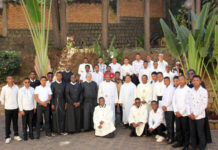

As part of the year dedicated to leadership for mission, the Redemptorist postulants and scholastics of the Saint Alphonsus House in Antananarivo received training on missionary leadership from April 29 to 30. This training program was conducted by the Redemptorist associate Agatino Manankajaina, President of the International Catholic Conference of Scouting – Africa Region, International Trainer, and Expert in Laudato Si’ and Development.
Mr. Agatino first presented the five objectives of his session: to strengthen the identity of leadership as future priests, to develop self-confidence and the ability for pastoral positioning, to understand the culture of belonging versus the culture of appropriation, and to integrate group dynamics into community and missionary life.


Over the course of one and a half days, he divided his presentation into six modules. In the first module, entitled Foundations of Christian Leadership, he presented leadership according to Christ, which is service before authority, and highlighted the difference between worldly leadership and evangelical leadership, based on the following biblical references: Mark 10:42–45 (“Whoever wants to become great among you must be your servant…”); John 13:12–15 (the washing of the feet); and the Social Doctrine of the Church, particularly the principles of the dignity of the human person and the common good.
In the second module, entitled Biblical Leadership, the speaker presented examples of leadership from several biblical figures such as Moses (leadership in mission and obedience), David (leadership with human strengths and limitations), Solomon (leadership and wisdom), Jesus Christ (the perfect model of leadership), and finally missionary and collegial leadership in the early Christian community according to the Acts of the Apostles. He also referred to the leadership style of their founder, Saint Alphonsus.
In the third module, entitled Personal Development and Inner Attitude, Mr. Agatino addressed the themes of self-confidence versus trust in God, inner authority versus functional authority, and the management of emotions and criticism, referring to 2 Timothy 1:7 (“God has not given us a spirit of fear…”).
In the fourth module, entitled Culture of Belonging vs. Culture of Appropriation, the speaker explained the culture of belonging, “I serve a mission greater than myself (Church, community)” and the culture of appropriation, “I take ownership of the mission” (risk of ego and power). He referred to 1 Corinthians 12 (one body, many members) and to the principles of subsidiarity and solidarity in the Social Doctrine of the Church.
In the fifth module, entitled Group Dynamics and Community Life, the speaker discussed community life (its richness and tensions), collaborative leadership, and conflict management, drawing on the testimony of fraternal life in the early Christian community in Acts 2:42–47.
In the sixth module, entitled Pastoral Leadership, Mr. Agatino explained how to position oneself as a leader in pastoral mission, how to make just decisions, how to accompany others without dominating them, and how to respond to clericalism and spiritual abuse, referring to Luke 22:26.
The method used by the speaker was characterized by short theoretical inputs, group work, biblical studies, role-playing, and experience sharing.
At the end of his presentation, the speaker offered the following advice: do not “managerialize” the priesthood; always link leadership with service, humility, and mission; respect the theology and hierarchy of the Church; and promote personal reflection rather than giving “ready-made formulas.”
In one sentence, Mr. Agatino summarized his presentation as follows:
“The priest is not a leader who seeks to be followed, but a servant who helps others follow Christ.”
Baltazar Baptista