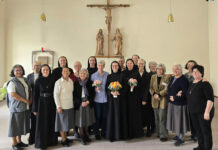

The situation at Spain’s borders, particularly in the Canary Islands and Ceuta, is marked by a serious migration crisis. Welcoming and accompanying project of the Oblates of the Most Holy Redeemer knows no borders or distances: for this reason, the nuns ensure a constant presence in Gran Canaria, Lanzarote, and Tenerife, to support and intervene directly with women living in prostitution on the islands.
The situation in the Canary Islands is critical due to severe pressure on the Atlantic route, particularly impacting small islands like El Hierro, and difficulties in resource management and border control. In the first week of November 2026, approximately 6,000 people arrived on El Hierro (an island of 12,000 inhabitants), overwhelming health services and reception facilities. The resulting saturation of centers in Tenerife and Gran Canaria has hampered the work of volunteers and the assistance of religious groups.
Also worth mentioning is the situation in Ceuta, which has been experiencing a serious migration and social crisis since the end of July 2026, following the mass influx of approximately 72,000 people across the border with Morocco (according to the Spanish Interior Minister, 70,000 of them had already returned to Morocco a few days later).


The Oblates’ response
In October, the Oblates of the Most Holy Redeemer organized training days in Gran Canaria, Lanzarote, and Tenerife for professionals and technical staff to identify the signs of human trafficking for the purpose of sexual exploitation, with particular attention to children and adolescents.
Three meetings brought together professionals from diverse fields to delve deeper into a reality still largely invisible and strengthen the tools needed to recognize it, especially in a migration context plagued by management challenges and a lack of guidance and resources.
For the Oblate Family, the mission of welcome and support knows no borders or distances. For this reason, since April 2026, the Oblate project in the Canary Islands has maintained its firm commitment to travel to Fuerteventura every month, ensuring a constant presence to support and intervene directly with women living in prostitution on the island. “We know, however, that for this intervention to be truly transformative, we cannot walk alone. It is essential to build alliances.”
Since the end of March 2026, after the institutional coordination meeting with the Island Director and representatives of the State Security Forces and Corps, the Oblates have been able to carry forward the project in the Canary Islands with greater determination and presence.
The primary objective of the project is now clearer: to continue strengthening networking to directly and effectively improve interventions for women in prostitution and victims of trafficking for sexual exploitation. Coordination between social resources and public institutions is essential to ensure the protection, rights, and safety of accompanied women.
The Oblates thank the Government of the Canary Islands, through the Department of Social Welfare, Equality, Youth, Children and Families, with the support of the Directorate-General for the Protection of Children and Families, for their collaboration and funding. They also thank the colleagues who participated as speakers, sharing their knowledge and experience, and all the participants for their interest.
Learning to recognize the signs is essential to identifying and protecting oneself.
@ProgramaOblatasDaniela – hermanasoblatas.org