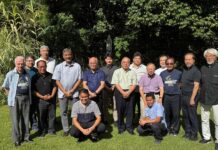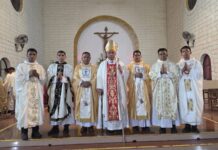

Last Saturday, December 13, Father Ercilio Duarte Cabrera CSsR, a member of the Pedro Donders Province, successfully defended his doctoral thesis in moral theology at the Alphonsian Academy in Rome, entitled “The Diaconia of the Confessor in the Formation of Conscience in Solidarity. The Significance of Some Alphonsian Elements for Our Time in Light of the Magisterium of Pope Francis.”
Father Ercilio was born in Yataity del Norte, Paraguay. He entered the seminary in 2002, made his perpetual profession in March 2010, and was ordained a priest in September 2011. His first missionary assignment was in Pedro Juan Caballero, on the border with Brazil. He then served for five years and four months as a missionary in the Redemptorist Province of Rome. Subsequently, he returned to Pilar, Paraguay, where he ministered for three years, before returning to Rome in September 2022 to pursue and complete a doctorate in Moral Theology.


We congratulate our confrere on his academic success. In sharing this happy news with the entire Redemptorist family, we would like to present a brief interview with the new Doctor of Theology.
Father Ercilio, congratulations on earning your doctorate from the Alphonsian Academy. Tell us a little about yourself. How would you describe yourself? A Redemptorist, a Missionary, A theologian?
I think what I identify with most is being a Redemptorist missionary. It’s my calling or missionary vocation. Being a priest or theologian comes later. I’m a Redemptorist missionary, and I like being called that.
What were the most significant moments of your religious life in the Congregation?
There have been many significant moments in my life in the Congregation. If I had to name some of the most significant, I would mention my novitiate and first vows. They were moments of deepening my Redemptorist spirituality and of intense community life. Furthermore, the year we professed perpetual vows was a very special moment in my history. Other important moments in my life as a Redemptorist included my experience as a missionary in the then Redemptorist Province of Rome, Italy, from July 2014 to November 2019. Finally, I can say that these doctoral years spent at the Generalate were invaluable, as they gave me a broad and international perspective on the life of the Congregation and its mission in the Church.
What prompted you to choose the diakonia of the confessor and the formation of conscience in solidarity as the topic of your thesis?
Since I began studying Moral Theology, my great inspiration has been Saint Alphonsus: his life, his missionary service, and his moral teachings. I had already written my master’s thesis in Moral Theology on Saint Alphonsus. In my doctoral thesis, I wanted to continue his teachings in light of the Magisterium of Pope Francis. Furthermore, I was inspired by the message the Pope addressed to the participants in the XXVI General Chapter of the Congregation of the Most Holy Redeemer (October 1, 2022), stating that Redemptorists are teachers of morality and formators of conscience; they are especially so in preaching, catechesis, and in the confessional. Moreover, in many of his speeches, the Pope has insisted on the current need to be in solidarity and practice solidarity, especially in times of the Covid-19 pandemic. This is how the key to my thesis’s theme, the diakonia of the confessor in the formation of conscience in solidarity, emerged, bringing the teachings of Saint Alphonsus into dialogue with those of Pope Francis. I am convinced that the service of the confessor continues to be very important in the formation of the conscience of the faithful.
What discoveries or lessons surprised you most during your research?
I was pleasantly surprised by the profound relevance of St. Alphonsus’ insights, by his proposal on the service of the confessor, a service of charity through the four offices of father, physician, doctor, and judge. Furthermore, by his great harmony with Pope Francis’s proposal regarding the confessor’s service in the formation of truly Christian, mature, and supportive consciences.
How do you think the concepts covered in your thesis can be applied to pastoral practice?
I believe that this thesis, without the practical application of the research made and the knowledge acquired, would remain merely a mental speculation. The topic I have studied is eminently practical. It can be put into practice through the concrete and persevering service of the confessional to the many faithful who need to be listened to, accompanied on their journey of faith, and constantly encounter the grace of God’s merciful and supportive love, which welcomes, heals, liberates, and integrates the community.
What advice would you give to other priests or lay people about forming consciences in their communities?
The fundamental advice would be to take the formation of one’s personal conscience seriously, as it is everyone’s duty and lasts a lifetime. May the priest persevere in ongoing formation, both academic and spiritual, in union and communion with Christ and the Church. May he not forget that he himself needs to continually form his own conscience, until the end of his life. Reaching the priesthood does not mean he no longer needs formation, it does not mean he is already perfect, that he has nothing left to change or transform in his life. I would advise the laity to allow themselves and their priests to be accompanied in the formation process. Formation is reciprocal, bilateral.
What are your next steps after completing your PhD?
First, publish my thesis, so I can properly close this chapter of my life. Second, return to my home province and make myself available to perform the service my superiors will direct.
Thank you so much, Father Ercilio. May God continue to bless your ministry and your journey of study and evangelization!
GR / Scala News