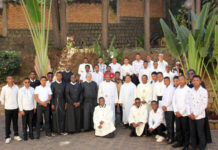

Conscience, digital technology, and Christian ethics were the focus of the training session held on March 24 at the Redemptorist College in Rome. Under the title “Moral Conscience in the Digital Age: An Analysis of Emerging Challenges in Digital Culture for the Development of Christian Ethics,” the College’s director, Father Anísio Tavares, C.S.R., guided the community members through the results of his doctoral research.
A topic of great current interest and relevance in theology—not only moral theology, but in all its disciplines—since the digital age has a global influence on today’s world.
The question posed is this: what is the importance of moral conscience in digital culture, and how can ethics and theology contribute at this moment in human history to the defense and promotion of conscience?
To address this issue, the training was divided into four phases.
The first traced the historical path of the treatise on moral conscience, showing its evolution over time: the Jewish cultural understanding—a God who speaks to the heart of man—and the Greco-Western understanding, syneidesis —a knowledge together with or shared knowledge—which evolved towards a function of evaluating one’s own conduct.


The reinterpretation of the Council of Trent would give rise to a morality detached from biblical and dogmatic spirituality, transforming into a juridical, legalistic, and casuistic one. In this context, Alphonsus Maria de Liguori adopted his equiprobabilistic proposal: a proposal always in favor of the universal nature of the vocation to holiness and salvation, which offered an evangelical approach grounded in the principle of the primacy of truth, the value of reason, conscience, freedom, and pastoral kindness.
This renewal of morality shows how we no longer start from the law, but how reasoning begins with conscience and the importance of affections, creating a link between spirituality and morality, and thus responding to a pastoral reality that has salvation as its goal.
With the masters of suspicion—Marx, Nietzsche, and Freud—the paradigm changes: it is no longer man who determines reality, but reality that determines the circumstantial condition of the human being.
Faced with this, the Second Vatican Council proposes a transition from juridical-moral self-referentiality to a morality that respects conscience in its meaning and in the value of its axiological and ontological dignity.
The second moment illustrated the relationship between the Church and the media, showing how the Second Vatican Council represented a great renewal of openness to dialogue with the contemporary world, believing in the conscience of the faithful and considering the media as an instrumental dimension.
With the advent of the Internet, the entire world underwent a virtually irreversible change: the dynamic was no longer instrumental, but pre-figurative. The Internet now created a qualified anthropology, a warm space we inhabit.
The third point was an analysis of the emerging challenges in digital culture for the development of a Christian ethic. Drawing on Gaudium et Spes 16, three dimensions of the human being were discussed: interiority (a space between God and humanity), exteriority (relationships with others in the search for truth), and formation (knowledge and discernment). This reality corresponds to a shift in temporality and spatiality. We are faced with a new ethos: the life onlife.
Finally, the focus was on moral conscience in the digital age. In this context, Pope Francis’s contribution was recalled, with his call for a new vision: from embracing the throwaway culture to multifaceted integration, broadening horizons, considering, and inhabiting the periphery as well. Because one consequence of digital technology is that it brings us closer to those far away, but distances us from those close by.
We must not forget, in the midst of a technologically advanced world, what defines Christian life: justice and the dignity of others. This is not, therefore, a matter of desk-bound moral theology: we will have to get our hands dirty, and we will need shepherds with the smell of the sheep.
In conclusion: the digital has changed reality and anthropology so profoundly that today it forces us to carefully reevaluate moral conscience.
Fr. Rodolfo García, C.Ss.R.