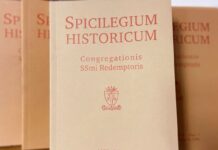

F. Sacco, Dust and Stars. An Interview Beyond Time, Editrice Punto Famiglia, Angri (SA) 2026, pp. 158.
Filomena Sacco’s volume is part of the vast body of work dedicated to Saint Alphonsus Maria de Liguori, but it stands out for its original approach and its informative nature. The work was created to mark the third centenary of his priestly ordination (1726–2026) and is presented neither as a traditional biography nor a theological treatise, but rather as a creative narrative, constructed around an imaginary interview “beyond time.”
The author, an expert scholar of Alphonsus’s thought, imagines a journey to the eighteenth century and a direct dialogue with the saint, in various symbolic places of his life. This narrative choice allows us to move beyond the rigid and distant hagiographic image, instead portraying a profoundly human Alphonsus: a passionate, restless man, marked by doubts, internal struggles, and a constant search for meaning. The decision not to emphasize his ecclesiastical titles reinforces this perspective, fostering a more immediate and authentic encounter with him.
Through the dialogue, a sort of spiritual autobiography unfolds. The key moments of his life are retraced: his brilliant career as a Neapolitan lawyer, the inner crisis that marked his separation from the legal world, his choice to become a priest, and finally the founding of the Redemptorist Congregation. Central to this is the experience of encountering the poor and marginalized, which marked a turning point in his life and guided his mission toward the “least,” considered the privileged place for the proclamation of the Gospel.
The narrative unfolds dynamically, alternating between past and present, intertwining the saint’s experiences with those of the interviewer, portrayed as a troubled figure, plagued by doubts of faith and existential questions. This intense dialogue makes the text engaging and allows for the translation of complex theological content into accessible, living language.
Ample space is devoted to the fundamental principles of Alphonsus’s thought. In particular, a conception of moral theology emerges as a concrete and pastoral discipline, far removed from a legalistic approach: sin is seen as an illness to be cured, the sacraments as instruments of healing, and conscience as a place of freedom and encounter with God. Central to this is the primacy of mercy, which guides pastoral action and the vision of humanity, considered in its fragility but also in its capacity for redemption.
Alongside these themes, the work explores the key elements of Alphonsian spirituality: prayer as a living relationship with God, the centrality of Christ in his Incarnation, Passion, and Eucharist, Marian devotion, and the value of grateful memory.
The saint’s pastoral method is also highlighted, characterized by simplicity, immediate communication, and attention to the people, also expressed through popular preaching and the use of music as a tool of evangelization.
The narrative is enriched by portraits of significant figures—family members, collaborators, and disciples—and by references to emblematic places in Alphonsus’ life, which contribute to the vividness of the narrative reconstruction. A complex and multifaceted picture emerges, intertwining the human, spiritual, and cultural dimensions.
In the final section, the dialogue takes on a universal value: the saint’s words become a response to the concerns of contemporary man. The resulting message is that of faith understood not as an immediate goal, but as a progressive journey, made up of setbacks and recoveries, sustained by hope and trust in divine mercy.
The text thus emerges as an effective tool for education and dissemination, capable of bringing young people, in particular, closer to the figure of Alphonsus Maria de Liguori, presented in a renewed, more authentic, and accessible guise. The work restores the image of a saint “on a human scale,” still capable of speaking to the heart and offering guidance in a context marked by confusion and the search for meaning.
Fr. Vincenzo M. La Mendola C.Ss.R.