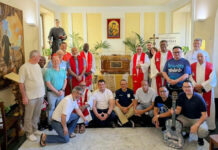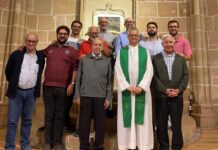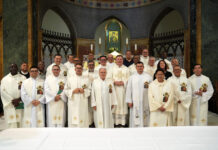

On May 1st, I walked into Notre Dame Retreat House for the first time in 30 years.
My last visit there remains vivid in my memory: Tim Keating hurrying through the hallway, always on the move; Artie Wendel in the chapel playing the organ as he prepared for the upcoming retreat weekend. For a moment, time seemed to stand still. The various pictures of Saint Alphonsus, depicting different stages of his life, were still hanging outside the chapel. Sunlight poured through the chapel windows, the red vigil light still burned near the tabernacle, and in the sacristy the chalices remained where they had always been, the closets still filled with vestments.
The silence and the memories carried me back to a place that once was.
But then things changed, and I was brought back to the present moment.
Suddenly the house became alive with the voices of 60 women arriving for the weekend retreat — old friends greeting one another, newcomers trying to find their way through the labyrinth of hallways, twists, and turns as they searched for their rooms.


Downstairs, a conference room was filled with 40–50 members of the Canandaigua Botanical Society holding their bi-annual gathering at NDRH. The invitation to host this local group has led to a wonderful partnership: they have committed themselves to helping refurbish the beautiful trails overlooking the lake.
In another smaller room, 18 men from St. Augustine’s Parish in Syracuse were gathering for a weekend of prayer, retreat, and fellowship. It was their first time at NDRH because the diocese had recently closed its two remaining retreat houses. They were deeply grateful to discover that retreat ministry was continuing here on the lake.
That evening, as the women gathered, I learned they had come not only from the Diocese of Rochester, but also from Buffalo, Ontario, New Paltz, and even Erie. Nine of the women were non-Catholics, searching for a place of prayer, quiet, and refuge in an increasingly busy and noisy world.
The next morning, in addition to those already there, a group of 18 women from a local Legion of Mary Curia joined us for the day. The dining room was filled with lively conversation, renewed friendships, and good food. The liturgies were full and prayerful, bringing a sense of centeredness to the entire weekend.
What a joy it was to be part of it all.
I know there were many mixed feelings about leaving Canandaigua. It was hard for the CSSR, and equally hard for the many people who loved the place. But then God stepped in and inspired a small group of people willing to take a chance.
And they did. And it is working.
The number of retreats continues to grow. The retreat house is becoming increasingly well known because there are now so few places left where people can step away, pray, and simply breathe. New groups are emerging, and the message is spreading: “We’re here. We’re open. And you are welcome.”
I want to commend that small group of dedicated people — the board members, volunteers, and staff who faithfully serve there each day. Their hopes and vision are becoming reality. The retreat house is operating in the black, much-needed improvements have been made, and although there is still much to do, there is also genuine hope for the future.
When the retreatants learned I was a Redemptorist, they were thrilled. They spoke of Tim and Artie, but also of Paul Miller, Mike Serge, Frank Jones, and countless others. They miss us, but they too are being led forward by the Spirit of God.
Perhaps there is also a lesson for us in all of this.
Over the years we have left many ministries, parishes, retreat houses, and apostolates. Every departure carries some sense of loss because part of our lives, our history, and our hearts remain in those places. Yet perhaps we also need to recognize the grace that comes when others step forward to carry the mission into the future.
What I witnessed at Notre Dame Retreat House reminded me that our ministries do not simply end when we leave. In many ways they continue to grow, often in new and unexpected ways, through the dedication of lay women and men who have come to love the mission as deeply as we once did — and still do.
Maybe part of our call today is not to be afraid of sharing the mission more deeply with the laity, inviting them not only to assist us, but to truly become partners in the work. They will carry the charism forward through their own gifts, experiences, and vision, while remaining rooted in the spirit that first gave life to these ministries.
That is not failure. That is continuity. That is the Spirit still at work.
So, brothers, if you ever have the opportunity to participate in one of their retreats, I encourage you to do so.
For me, what began as a trip down memory lane ended as something very different. I discovered that life is still being lived there in the present moment. We can look back and say, “We once did great work there,” but perhaps we can also pause and recognize something even more important:
Our presence is still there.
Fr. James McDonald, C.Ss.R.