


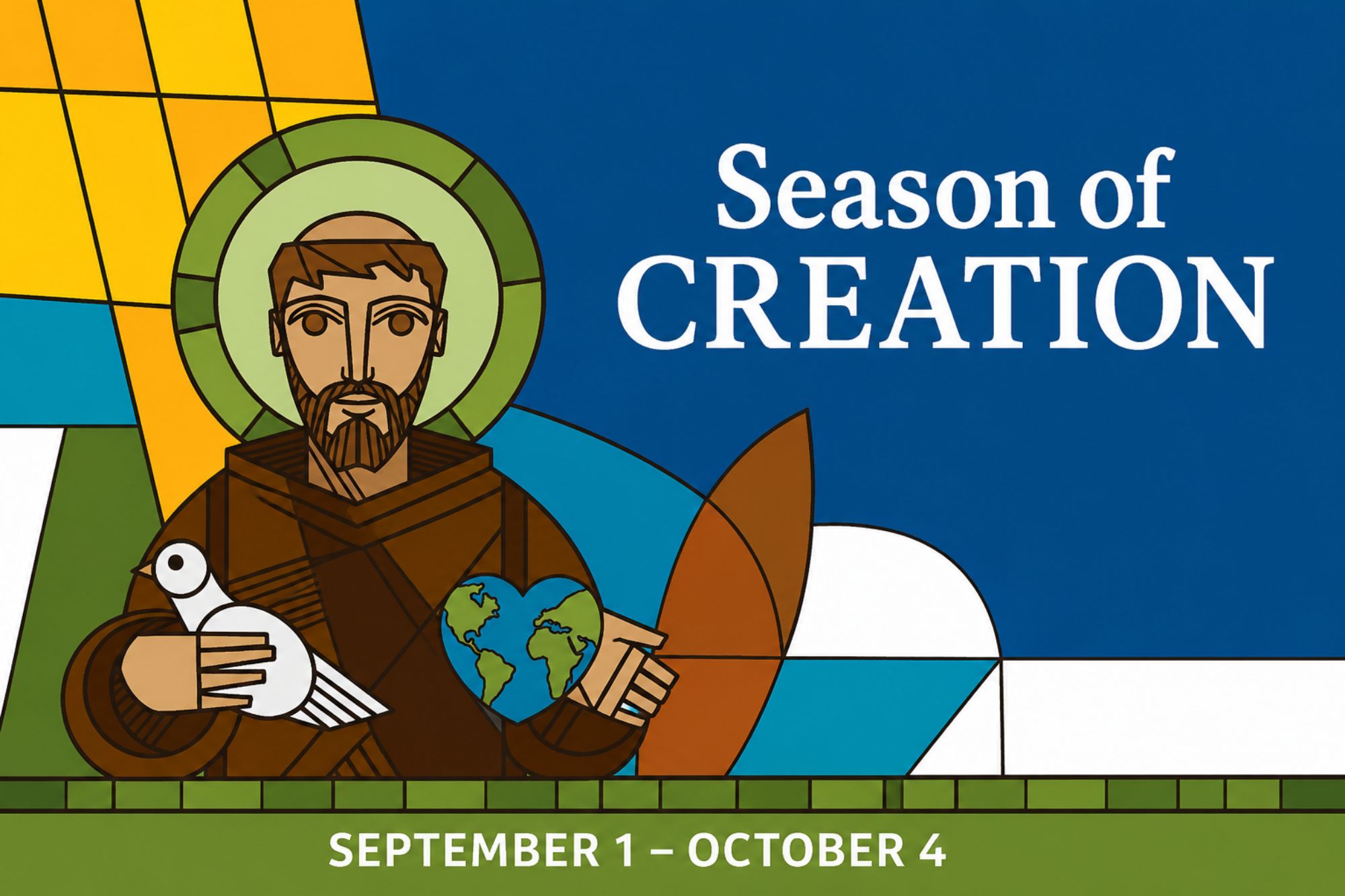
September 1 – October 4
WITNESSES OF HOPE FOR OUR COMMON HOME
World leaders are preparing for the next United Nations Climate Change Conference (COP31) in 2026, to be held in Antalya, Turkey, from November 9 to 20, 2026. Meanwhile, the planet continues to experience record-breaking temperatures each year, marked by droughts, floods, and other extreme weather events that disproportionately affect the poorest communities, threaten biodiversity, and accelerate the degradation of soils and aquifers. So, how is our Redemptorist charism related to this situation? And, specifically, how is our charism called to respond to these environmental challenges?
Undoubtedly, the environmental question has become a sign of our times and, therefore, a matter of discernment for us, disciples of the Redeemer. In recent years, the need to integrate the care of our common home into our apostolic work as Redemptorists has matured. We understand ourselves as collaborators in the work of Redemption (cf. Const. 47), and it is this participation in the Redeemer’s mission that leads us to proclaim the Good News of salvation to all creatures and to all creation.
MESSAGE FROM HIS HOLINESS POPE LEO XIV
The current ecological crisis is largely due to the anthropocentric attitude toward nature, characterized primarily by a dualism that views nature as something “wild” to be conquered and entirely distinct from the human person. This anthropocentric attitude has often been supported and justified by inadequate theologies. From our charism, we believe that abundant life offers light and hope for the restoration of communion between humanity and nature. Moreover, we believe that salvation, which consists not so much in what human beings can obtain for themselves, but in union with Christ the Redeemer, is also expressed in the restoration of our relationship with the created world. Salvation bears the name of Jesus Christ, and his redemptive work encompasses all of creation. He is, “at the same time, the Savior and Salvation” (Congregation for the Doctrine of the Faith).
The foundation of our spirituality lies in the mystery of Christ: his incarnation, life, death, and resurrection. This spirituality is manifested in the promotion of abundant life, especially for the poorest and most abandoned. This apostolic ministry is informed and updated within the context of history. For this reason, the communicanda on mission (2025) invited us to contemplate our mission in history, that is, in light of the emerging challenges of today’s world, where global warming and the environmental crisis constitute two of its most pressing problems. One way to understand abundant Redemption, in the words of Pope Francis, is in terms of integral ecology. Our faith in the Redeemer is defined not so much by what one thinks of the Redeemer, but, above all, by the way in which we relate to Him and to the very fact of redemption. Redemption encompasses the whole of creation, which groans in the pains of childbirth and awaits its liberation (cf. Rom. 8:22).
In this sense, we need to recover the sense of “symbiosis” and interdependence among living beings. The individual is not an isolated entity, but rather part of a larger organism. Our Christian life is an effort to enter into and participate in the mystery of the Trinitarian communion, so that our mission becomes a reflection of that communion. We live in a world where the rescue of some at the expense of others is not possible. There is salvation and survival only together; let us recall Francis’s words at the beginning of the COVID pandemic: “We are all in the same boat.” This includes not only a new relationship with nature, but also with one another. The “psychology of separation” must give way to an “epistemology of participation.” The “generation of the self” must yield to the “generation of the we.” The “instrumental” reason of the modern world needs the complement of “communicative” reason (Habermas), because human existence is, by definition, an intersubjective existence.
The Communicanda on mission reminded us that “the central problem of mission today no longer revolves so much around the idea of God, but rather how that idea can foster a better world, where justice and fraternal relationships among people and with creation flourish.” The problems afflicting the world, such as the threat of war and environmental degradation, particularly affect the poor, our intended recipients of the mission. The relevance of the Redemptorist charism will depend on our ability to proclaim abundant redemption amidst these emerging problems and on our capacity to engage in the great common project of all humanity.
The biblical text and the symbol of the Season of Creation, which we will celebrate from September 1st to October 4th, remind us of the abundant life that flows from the Trinity. The call is for us to immerse ourselves in this Living Water and be missionaries of hope for our Common Home as well. It is about embracing what Pope Leo XIII asks of us: a “deeper personal and collective conversion,” a path of “ecological conversion where the effects of our encounter with Jesus Christ become evident in our relationship with the world around us.”
General Commission for Justice, Peace, and Integrity with Creation (JPIC)
More information at: www.seasonofcreation.org


