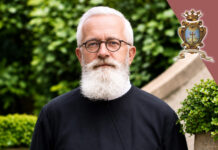

“In a world scarred by war, division, and environmental crisis, the call to be peacemakers has never been more urgent.” On the 59th World Day of Prayer for Peace, Fr. Rogério Gomes, CSsR, Superior General of the Redemptorists, invites us to ‘reimagine’ our mission as witnesses to hope and builders a disarmed peace.
Fr. Rogério Gomes writes in his message to the Redemptorist Family on the occasion of the World Day o Peace 2026: “We cannot help but think of the war that Ukraine is currently enduring and that our Redemptorist confreres are experiencing firsthand. Likewise, we turn our gaze to the peoples of Nigeria and of West and Central Africa, where our confreres are also present and where many communities continue to be threatened in their lives and integrity, living under the constant fear of forced displacement. The anguish and anxiety of our confreres and communities in these territories marked by violence and war are a constant reminder that our Congregation fully participates in the mission of Christ the Redeemer in the world (cf. Const. 52). This participation calls us to be builders, proclaimers, and witnesses of his peace. The Redeemer is our peace (cf. Phil 4:7; Eph 2:14–16), and our proclamation of redemption and abundant life necessarily includes a commitment to the proclamation and promotion of peace.“
Read the complete message of the Superior General below:
Rome, January 1st, 2026
Solemnity of Mary, the Holy Mother of God
Missionaries of Hope in the Footsteps of the Redeemer
YEAR DEDICATED TO THE MISSION
The Lord sends us as Missionaries and Pilgrims of Hope in a Wounded World
Lk 4:16-19, Mk 6:7-12, Lk 9:2-6, Ps 130:7 Const. 1-20, Est. 01-020
MESSAGE FROM THE SUPERIOR GENERAL
FOR WORLD DAY OF PEACE 2026
Peace be with you all: towards an “unarmed and disarming” peace
Dear Confreres, Formandi, Redemptorist Family, and Lay Associates in our Mission,
- The song “Glory to God in the highest, and on earth peace to people of good will!” (Lk 2:14) continues to resonate in our hearts as the proclamation of the peace that springs from Christmas Eve and illuminates the path of humanity. The contemplation of the mystery of Jesus in the manger, together with Jesus in the Eucharist and Jesus on the cross, has always been one of the privileged focal points of our spirituality and mission. Reflecting on the fact that the Child lying in the manger is the same innocent Lamb sacrificed on the cross helps us to recognize the face of the Redeemer in the faces of the children who today suffer the consequences of war.
- [1] and the Global Peace Index[2] , the world is currently experiencing one of the most violent periods since the end of World War II. In 2024, there were 61 armed conflicts involving at least one state, the highest number since 1946, of which 11 reached the level of war. Although the total number of deaths showed a slight decrease compared to 2022, nearly 160,000 people died as a result of organized violence, making 2024 the fourth most violent year since the Rwandan genocide in 1994. The war in Ukraine continues to be the deadliest conflict, while in the Middle East, especially in Gaza and Lebanon, violence has disproportionately affected the civilian population. Alarmingly, violence targeting civilians has increased significantly, as has the internationalization of conflicts, with 92 countries involved in wars outside their own borders. At the same time, according to the International Committee of the Red Cross, there are currently more than 120 armed conflicts around the world, many of which have been overlooked by the international community but are marked by serious violations of international humanitarian law that undermine the human dignity and fundamental rights of millions of people.
- This scenario highlights the urgent need to strengthen the protection of civilians, peacebuilding efforts, and global commitment to dialogue and justice. It is worth recalling that, in many of these contexts of conflict, our Redemptorist mission is present, sharing in the suffering caused by war and, at the same time, becoming a source of support and a sign of hope for the innocent who endure its consequences.
- The World Day of Peace was inaugurated at the initiative of Pope Paul VI, who, in 1967, two years after the close of the Second Vatican Council and in the midst of the Vietnam War, proposed beginning the calendar year with hopes and aspirations for peace as a driving force in the shaping of human history. In a context of growing polarization, the call to be peacemakers remains both necessary and relevant, and we must view it as an opportunity to “reimagine” our mission and our religious identity in today’s world. As the world continues to undergo profound transformations, we strive to interpret them and to discern our role as Missionaries of Hope and Witnesses to abundant life in the Redeemer. Our listening to the world ultimately seeks to respond to the cry of peoples, especially the poorest (Dt 9:1), and to the cry of the Earth itself (LS 2; 49).
- On this 59th Day of Prayer for Peace, the Church invites us to focus on a disarmed and disarming peace. Armed conflicts and the nuclear threat continue to sow persistent fear and to test our hope. We live in a multipolar world in which the great powers seek to maintain primacy or, at least, to be protagonists in a new world order perceived as fragile. Today, we are witnessing cruel and fratricidal wars that destroy lives, especially those of the poorest. While much of the responsibility for building peace lies with world leaders, from our faith and our charism we also assume our share in the common task of promoting and building peace. In this regard, Pope Leo XIV recently reminded us that today’s world needs “a Church that sets no limits on love, that knows no enemies to fight, but only men and women to love” (DT 120).
- It is deeply symbolic that today, in one of the churches in Bethlehem, the nativity scene has been set up on a pile of rubble, upon which the Child Jesus lies. Similar scenes have been seen in churches in North America, where the Holy Family appears detained, separated, or surrounded by elements that evoke fear and despair. In the current war in Ukraine, many children have been forcibly separated from their families and their culture; others have died, buried beneath the rubble of their own homes, destroyed by indiscriminate bombardment. This is the world that the Redeemer visits this Christmas, and in which the angels’ proclamation resounds once again: “peace on earth.”
- Pope Francis, for his part, without resorting to subterfuge, used to speak of a “third world war in pieces” to refer to the reality of numerous localized conflicts that employ both conventional and hybrid tactics and have profound repercussions on a large part of the world’s population, including our communities. In this context, the Gospel, as Good News, always impels us to act as missionaries of hope.
- As mentioned earlier, we cannot help but think of the war that Ukraine is currently enduring and that our Redemptorist confreres are experiencing firsthand. Likewise, we turn our gaze to the peoples of Nigeria and of West and Central Africa, where our confreres are also present and where many communities continue to be threatened in their lives and integrity, living under the constant fear of forced displacement. The anguish and anxiety of our confreres and communities in these territories marked by violence and war are a constant reminder that our Congregation fully participates in the mission of Christ the Redeemer in the world (cf. Const. 52). This participation calls us to be builders, proclaimers, and witnesses of his peace. The Redeemer is our peace (cf. Phil 4:7; Eph 2:14–16), and our proclamation of redemption and abundant life necessarily includes a commitment to the proclamation and promotion of peace.
- The Gospel we proclaim is, by its very nature, a Gospel of peace. Therefore, peace must concern us all, not only the leaders of nations, but also those of us who profess to be missionary disciples of the Lord of peace (cf. Is 9:6; 2 Thess 3:16). The Redeemer offers it (cf. Jn 14:27) as a gift, yet at the same time it is received as a human achievement and responsibility. For this reason, peace can be attained only by joining forces with members of other religions and institutions who, in many ways, are committed, like us, to promoting justice, peace, and care for creation. Unfortunately, international organizations and the will of world leaders alone are no longer sufficient to guarantee and safeguard peace and justice among nations. It is here that our ministry, our “few loaves and few fish”, though they may seem insignificant, take on their true relevance and can become a leaven of redemption within the fabric of society. This ministry is carried out in collaboration with our lay partners, as well as with institutions and with men and women of good will who work for this common good that is peace
- During his visit to Beirut, Pope Leo called on all of us to do our part so that our world might regain its splendor: “And there is only one way to do this: let us disarm our hearts, lay aside the armor of our ethnic and political closed-mindedness, and open our religious confessions to mutual encounter” (Beirut, December 2, 2025). In a globalized and multireligious world, we cannot shirk our responsibility to encounter one another, to engage in dialogue, and to work together for this common good. Some confreres carry out their missionary ministry precisely in hostile contexts; they encourage us through their witness and creativity in fostering spaces of dialogue and reconciliation.
- In this regard, the contribution of the Redemptorist Bernhard Häring (1912–1998) is particularly illuminating. In his moral reflection, he insisted on the urgency of forming a nonviolent, healthy, and mature Christian conscience. For him, peace does not arise from imposed balances or from the mere absence of conflict, but from a profound interior conversion that frees individuals and communities from the logic of confrontation, resentment, and domination. Grounded in the centrality of the Gospel, Häring reminds us that believing in Christ, who is our peace, implies allowing ourselves to be transformed at the very roots of our existence, so as to participate actively in his nonviolence and in his reconciling and healing love. This evangelical option, far from passivity, forms our conscience to reject all forms of exploitation, hatred, and revenge, and commits us to building personal and social relationships marked by truth, justice, and forgiveness, as a concrete path toward authentic and lasting peace.
- I would like to take this opportunity to highlight peace with creation as another aspect that strongly challenges our charism today. The destruction of the environment can be seen as yet another manifestation of the conflictive nature of the human person and a reality that our charism is called to address. The encyclical Laudato Si’ has become a fundamental milestone in the Social Doctrine of the Church, helping us to better understand the profound interconnection between our faith in the God of life and the care of creation, as well as between the redemption of the human person and the redemption of all creation. To deepen this dimension, the Church has for several years celebrated the “World Day of Prayer for the Care of Creation” on September 1. In the same vein, Pope Leo promulgated the decree establishing the formulary for the “Mass for the Care of Creation” (Missa pro custodia creationis), which invites us to become more aware of the profound relationships between God and his creation. Thus, an essential aspect of the search for peace also involves the restoration of relationships and reconciliation with all creation. With regard to the purpose of our missionary action, the Constitutions speak of our election to the ministry of reconciliation (cf. Const. 11). And if everything in our lives is interconnected (cf. LS 34), the search for peace and reconciliation must also include the healing of broken relationships between the Creator and us, his creatures
- To Mary, the Theotokos, through whom we receive true peace and reconciliation with God, and to whose care we entrust ourselves at the beginning of this year, we ask that she continue to inspire us in following her Son. He proclaimed blessed those who work for peace, for they will be called children of God (cf. Mt 5:9). Mary rightly proclaimed that all generations would call her blessed (cf. Lk 1:48), and through her witness of faith she continues to inspire us to build a world in which love conquers hatred, truth overcomes lies, and reconciliation prevails over vengeance.
Fraternally,
Fr. Rogério Gomes, C.Ss.R
Superior General
Original: Spanish
[1] Cf. Organized Violence & Armed Conflict Trends 2024 (UCDP Data). https://ucdp.uu.se/year/2024
[2] Cf. World Map of Peace and Conflict Indicators. https://www.visionofhumanity.org/maps/#/