
Students of the North American Conference enjoyed the hospitality of the Redemptorist Retreat Center in Oconomowoc for our annual Student Gathering. We were immersed in nature – surrounded by lush green oak trees and the chirping of birds – for three days last week. Fr. Charles Vijay Kumar of the Province of Bangalore served as our keynote speaker and presenter, with the theme of understanding Artificial Intelligence (AI) in the modern world. The key document of the week was Missionaries in the Digital World, published by the General Government.
Fr. Charles took us on a journey that opened our minds to opportunities that this new Digital Continent has to offer. He emphasized the necessity of technology today, and said that we are in a unique position because the Church proactively supports us. We broke into small groups to discuss AI, learn to use it, and brainstorm ways AI can be used as a ministry tool.
Fr. Charles encouraged us to follow the example of St. Alphonsus, who went to the people and spoke their language. If people are looking for answers in the digital space, we must be there, too. But this presence shouldn’t take away from our Redemptorist identity as Kitchen Table Missionaries.

Fr. Kevin Zubel, Provincial Superior, preaches at a Mass presided by Fr. John Collins, Provincial Superior of the Baltimore Province 
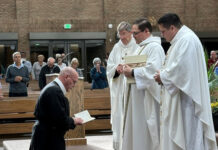
Fr. Aaron Meszaros, Fr. Kevin Zubel and Fr. Anthony Nguyen accept the vows of William Pasold, Andrew Tran-Chung, Cody Hill and Antonio Montoya 
Fr. Charles Vijay Kumar of the Province of Bangalore, founder/director of the Redemptorist Media Center in India who serves as publisher/director of Redemptorist Publications India and Director of Media at Liguori Publications, leads a presentation on AI 
Redemptorist students who renewed their vows during the Student Gathering 

the participats in the annual Student Gathering near the shore of Crooked Lake.


In addition to discussing the Congregation’s digital presence, we explored our own personal digital journeys. Speaking of digital comparisons, Fr. Charles drew on words of wisdom from his Novitiate days: when we say “yes” to something, we are saying “no” to something else. The question, then, becomes: when we are present in the digital world, where are we absent? When we plunge into the digital world, there is a cost. God has given each of us unique talents, and to compare ourselves online is to deny this fact.
On the second day, Fr. Charles walked us through how common AI is, and the fields currently using it: education, health, publishing, science and technology, faith ministry, and spiritual life. He drew on his experience directing the Redemptorist Media Center in Bangalore, where AI is used to generate content, such as music videos and animations, and to write homilies. He echoed Pope Leo’s advice on the importance of the human presence the human touch. In addition, he presented different AI models that he has found helpful in ministry. He said that if St. Alphonsus were here with us today, he would be echoing the same message.
On the third and final day, we reflected more specifically on AI and its use in Redemptorist ministry. Fr. Charles explained his own parameters for AI use, as he created a homily. He explained the seven steps to creating a homily: prayer, Scripture reading, research, finding the theme, formulating the homily, preaching, and praxis. AI can be used effectively in the research, theme-finding, and formulation steps.
AI can help us research social contexts and other background information related to the Scripture reading. It also can help us identify a theme. A simple question like “Can you help me bring this together?” allows us to integrate AI into the formulation step of homily writing. Fr. Charles explained how “preaching” into the AI can help with polishing the rough draft. However, there are discernment questions we must ask ourselves when we bring AI into our homily writing or other dimensions of ministry: What was useful? What part of the AI’s response lacked my own individuality? What requires further discernment? Fr. Charles ended his presentation by cautioning us about the privacy risks that are involved with AI. The data we give to all the different AI models can be shared at any time. We must exercise great caution when providing information to AI.
Each day, we broke into small groups to discuss the presentation and our own personal experiences with AI. The common theme was to use caution. Some positives were highlighted, including how AI can aid in administration, preparation for exams, and conducting academic research. Group discussions stressed that AI should not be used in ministry because it lacks an authentic human connection. It was noted that students may overburden or expect too much of themselves, which pushes them to rely heavily on AI and lose a genuine human connection.
St. Alphonsus used libraries and the patristic tradition, but his genius was in synthesizing that material based on his experience with the people he encountered. If we rely too much on AI, we risk missing the genius of St. Alphonsus. We must use AI with great care to preserve our human dignity and our unique individual characteristics.
Students also took advantage of opportunities to spend time together and explore all that Oconomowoc and the surrounding towns have to offer. We took some time to decompress with a game of bowling in Waukesha. Others explored the property and went on hikes, and a few students took the canoe out on a fishing expedition around Crooked Lake and made some great catches! On the last full day of our gathering, a group of students went to the Shrine of Our Lady Help of Christians commonly known as Holy Hill.
As is customary on the final day of Student Gathering, we gathered in the newly renovated chapel to witness the renewal of vows of our professed students who are currently studying in San Antonio. Fr. John Collins, Provincial Superior of the Baltimore Province, presided at the Mass, and Fr. Kevin Zubel, Provincial Superior of the Denver Province, preached. In his homily, Fr. Kevin emphasized the theme of embracing our differences. He explained that if someone presented, as a business proposal, a group of men from very diverse backgrounds a motley crew working together and living together that idea would surely be rejected. Yet here we are, almost 300 years later, guided by the Holy Spirit. We may be different, but it’s in the way we encounter our differences that we build true brotherhood one that doesn’t set aside our differences, but embraces them.
These annual gatherings bring students and confreres from diverse walks of life together to share their experiences and lift up one another. As the Provinces of Denver, Baltimore, and Mexico prepare to form the new Seelos Province of North America, we are reminded that community is our foundation. We bridge our differences in and through community all for the sake of the mission.
By Adam Tran-Chung
Source: denverlink, May 29, 2026.
Photos by Andrew Tran-Chung & Adam Tran-Chung