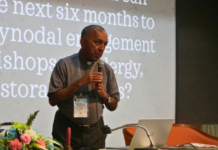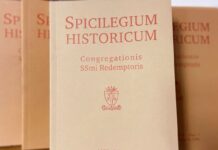

The book by Antonio De Luca and Enzo Rispi was presented in Marina di Camerota (SA).
In the splendid setting of the Cilento Riviera of Marina di Camerota, between the blue of the sea and the rugged mountains, in the monumental neoclassical church (1874), seat of the parish dedicated to St. Alphonsus Maria de Liguori, the recently published volume on the holy founder of the Redemptorists, by Antonio De Luca and Enzo Rispi, S. Alphonsus M. de Liguori. A missionary of hope (Edizione Diocesi Teggiano Policastro, Teggiano (SA) 2025, pp. 93), was presented on Monday 11 August.
The patron and impeccable organizer of the event was Don Gianni Citro, the parish priest of Marina di Camerota and Lentiscosa, already known for his many cultural initiatives and a passionate admirer of the Saint. For the presentation, he chose to highlight a unique work of art, placing it at the center of the stage, which dictated the theme of the event. We are talking about a previously unseen canvas of Saint Alphonsus, from the Campania region, recently acquired and placed in the church’s presbytery, already rich in valuable works of art. The portrait of the Saint, painted, as an inscription on the back attests, just nine years after his death (in 1796), offers us one of the first portraits of the then Servant of God , executed by the ingenious brush of some expert, anonymous local portraitist, who probably—we do not rule out the possibility—knew him personally. The Saint’s face, slightly reclining on his right shoulder, is characterized by a lively and penetrating gaze, in his calm serenity, a charming and witty smile, as he embraces a crucifix with his left hand and places his right hand over his heart, as if to indicate his great human and spiritual sensitivity. Taking part in the event and admiring the work brought Saint Alphonsus closer to those present, reconnecting, symbolically and visually, that uninterrupted empathy between him and the people.


The evening began with an introduction by Father Gianni, who, in addition to welcoming Bishop Antonio De Luca and the numerous participants, announced the event’s program.
The first part of the evening was dedicated to the presentation of the book, elegant and practical in its pocket-sized format, as Father Gianni explained. Engaging in a spontaneous conversation, the host and the bishop focused on some key points of the text, offering those present a glimpse of its content.
The second was a tribute to the Neapolitan saint and his musical genius, with a masterful performance of seven organ pieces, performed on the magnificent eighteenth-century pipe organ located in the church’s choir loft. Maestro Anna Bardaro, on the keyboard, provided attendees with a truly sonic delight.
The conversation began by focusing on one of the unmistakable characteristics of Saint Alphonsus’ personality: his practical spirit , combined with his theological thought, which made him one of the greatest exponents of the Enlightenment and Humanism – as was reiterated several times during the various interventions – as well as one of the greatest European thinkers of the modern era, whose works have been published in more editions than those of Shakespeare.
Father Antonio de Luca, after thanking those present and expressing his appreciation for the evening’s creator, described the practical nature of Saint Alphonsus, especially in solving human problems related to the moral life. He shed light on the modern vision of man and the re-examination of the role of moral law, which form the fundamental core of his thought. He also emphasized Saint Alphonsus’s closeness to ordinary people, the starting point of all his theological and pastoral initiatives, and the underlying theme of his recently published book.
The second theme arose from a timely reference to an event in the life of the Holy Doctor involving one of his most famous disciples: Saint Gerard Majella. Beginning with this comparison, at first tragic, then moving, Monsignor de Luca, with effective brushstrokes, sketched the explosive humanity of Saint Alphonsus, his sensitivity, and even his ability to be moved by the disarming simplicity of his holy brother. He then recounted, with evident pathos, several episodes from the life of Gerard Majella, drawn from the beatification processes, which revealed previously unknown details of his sanctity and supernatural manifestations, in which Saint Alphonsus himself initially struggled to believe. Two artistic statues of the aforementioned saints are part of the sacred building’s heritage and are objects of veneration by the faithful.
The third question, posed with refined insight, focused on a key topic of the Saint’s pastoral intuition: his work of formation and promotion of the laity in the evening chapels. Referring to a memorable passage from the Alphonsian epic, Don Gianni, with an underlining of “ok,” sought to reaffirm the contemporaneity of Alphonsus’s thought and pastoral practice. His interlocutor’s timely response further highlighted the modernity of Saint Alphonsus’s pastoral vision, fully in tune with his universal promotion of holiness. “Saint Alphonsus is the one who announces hope to the hopeless,” De Luca began. “Through evangelization, he has always acted for the advancement of the human person, and especially of society’s outcasts.” His approach to proclaiming the Gospel, using simple language and all the communication tools at his disposal, brings him immediately to our times, where communication, through the media, is the key to understanding contemporary man and his rapidly changing mentality. Alfonso is a great communicator, empathetic and effective, Master of Communication techniques that he places at the service of the Gospel of Hope. He speaks to the heart, and does so with the heart, reaching an ever-increasing number of recipients with his spoken and written words, through art, music, and journalism, without exclusion or partiality. His example inspires the Church, which for many years has been hailed as an outgoing community, fully immersed in the new evangelization, as is repeatedly affirmed throughout the book, which also draws useful comparisons with the Church’s most recent teachings.
The final topic focused on the theme of Hope, recalled in the title and the leitmotif of the Jubilee, appropriately nicknamed “of Hope.” In what sense was St. Alphonsus a herald and missionary of Hope, asked Father Gianni, and what can he say to us today on this central theme of Christian life?
St. Alphonsus restored hope to all—De Luca immediately clarified—by opening up the possibility of universal salvation, in a complex and difficult era, marked in theology by Jansenist rigorism and a pastoral practice that penalized and led to despair. He forcefully proclaimed the abundant Redemptio, placing the Paschal Mystery at the center of his message, and at the same time promoting the human person, in all its dimensions.
The questions, posed with insight and supported by timely quotations from the text, and the answers, instantaneous and lively in their linear exposition, have contributed to sketching a more contemporary profile of Saint Alphonsus, close to man and his journey, and to presenting his prophetic significance, for the intuitions that anticipated by a few centuries the ecclesial itinerary, which reached its peak in the turning point of Vatican II.
An attentive and engaged audience expressed their appreciation with a rapt silence and a burst of thunderous applause. It goes without saying that all the copies of the book were snapped up, with the request for a dedication requiring Monsignor De Luca, as is customary, to autograph every single copy, further testament to the appreciation and interest it generated.
Also present were several priests from the deanery and the provincial superior of the Redemptorist Fathers, several nuns representing nearby religious communities, and many tourists, drawn by the unique occasion, which represented a moment of formation and cultural growth.
The event’s complete success truly fulfilled the authors’ hopes in the book’s dedication: In this Jubilee Year, dedicated to hope, may our Diocese rediscover the figure and work of St. Alphonsus de Liguori, a witness of hope (p. 3).Beginning in Marina di Camerota, St. Alphonsus and his message are once again at the center of the reflections of the Church of Teggiano Policastro, where his cult is widespread, along with that of St. Gerard, and where Redemptorist spirituality has deep roots, thanks to the long-standing government of another Redemptorist bishop, Monsignor Nicola Maria Laudisio (1779-1862), who led the diocese of Policastro from 1824 to 1862, and to the preaching of numerous popular missions, as attested by the many memorial crosses scattered throughout the territory.
Fr. Vincenzo M. La Mendola C.Ss.R.